Posts

Emily Dickinson and the Mystery of the 40 Fascicles

This post was supposed to go up on Halloween, but let’s settle for Day of the Dead. In short, I’m preparing to teach another Creative Retirement Institute course on Emily Dickinson, this one titled “Emily Dickinson and the Mystery of the 40 Fascicles,” which to my mind has a nice Arabian Nights or maybe Nancy Drew vibe to it. As you might guess, one of our objects will be to discuss the poems in the context of the fascicles, including this poem, “One need not be a chamber – to be Haunted – ” which is found in Fascicle Twenty.

Read to the end of the post (or skip down there) to see more information about the course.

One need not be a chamber – to be Haunted –
One need not be a House –
the Brain – has Corridors surpassing
Material Place –                                              Corporeal [Place – ]

Far safer of a Midnight – meeting
Eternal Ghost –
Than an Interior – confronting –
That cooler – Host –                                       That Whiter Host.

Far safer, through an Abbey – gallop –
The Stones a’ chase –
Than moonless – One’s A’self encounter –
In lonesome place –

Ourself – behind Ourself – Concealed –
Should startle – most –
Assassin – hid in Our Apartment –
Be Horror’s least –

The Prudent – carries a Revolver –                The Body [carries] the
He bolts the Door –
O’erlooking a Superior Spectre –
More near –

—Emily Dickinson,  c. Autumn 1862

(Miller, p. 217)

You can listen to me read our haunted poem here:


I want to fill in some background for where my ideas for this course originated.

from emilydickinsonmuseum.org

Two years ago, I was invited to audit Professor Cristanne Miller’s U of Buffalo graduate seminar focusing on the, at that time, not-yet-released Letters of Emily Dickinson—the first new edition in 70 years, much needed—edited by Miller and Domnhall Mitchell.

I attended the class via Zoom, of course, and my anonymity allowed me to resist buying one more edition of Dickinson’s poems. I got by with Thomas H. Johnson’s 1971 one-volume Selected Letters, his 1961 one-volume Complete Poems of Emily Dickinson, and Ralph Franklin’s 1999 reader’s edition, The Poems of Emily Dickinson. All of which were already on my big shelf of Dickinson books. After the seminar ended, convinced of their necessity, I bought both the poems and the letters.

I want to emphasize this: An important feature of Emily Dickinson’s Poems: As She Preserved Them, also edited by Miller, is contained in the subtitle. We can, finally, in a one-volume, reader’s edition, see Dickinson’s fascicles, the little booklets into which she arranged her poems from 1858 to 1865. Dickinson’s variant words, too (see margin notes) are included in this edition.

After these gorgeous new editions sat on my shelf for several months, it occurred to me that I might actually read them.

From there I conceived of a project called “My Year of Reading Dickinson.” Last November, before my year officially began, I told my friend, poet and scholar Jayne Marek, that I had no idea what it should look like. Though I hoped to share the project in some fashion, it felt lumpy and shapeless. Jayne suggested that I just put my boots on and get started. “Read for a few months or the whole year, then decide what it is.”

As you know, this past year a bunch of other stuff took over much space in my haunted brain, but even on the absolute worst days, I have picked up the letters and read a page or two, and I have read at least a few poems—usually more. Because I get up at dark-thirty and my husband rises at 8:00, I had time for this. (More than once I’ve awakened at midnight, realized I hadn’t done my pages, and got out of bed to do so.) I can now report that I’ve finished both volumes, and am circling back to reread and make more notes.

Speaking of that long shelf of books about E. D., I have also tried to keep a biography or critical work going on the side. And I have shared a little. Last winter’s Creative Retirement Institute course on Dickinson, for instance. I will share more, though I’m still not sure what that sharing will look like. Blog posts? A new blog, dedicated to Dickinson? Or will I venture into the Substack world? For now, I’ll be pouring a lot into the class, and mining the discussion for possibilities.
So all that blather, only to circle back to the beginning of the post. I’d love to see you join us for the CRI course. It’s on Zoom and runs 4 Tuesdays, 2 hours per class, beginning November 18. Jump straight to the course from the above link, or check out CRI’s catalog here.


Year’s End

It is New Year’s Eve — though this will post as January 1. Anyway, just a few thoughts to wrap up 2024 here at A Habit of Writing.

BUYING BOOKS?

Earlier this year, a reader asked me, Where do you find your books? The library, I think I said, or friends give them to me, or people send me a book with a request for a review. Thriftbooks.com is a good source when I need to purchase a book.

Well, forget that. This year I lost my mind and spent a ton of money on poetry books.

I’ve read a couple of these (see pic) — I have reviewed none.

My best excuse is that it was self-soothing behavior. Remember my spring CRI course, “Good Poetry for Hard Times”? Months ago I was already freaked out about the election, about Ukraine and Gaza, about climate change, and so on (and on).

Unsubscribing from a number of news feeds has helped. And poetry has helped. As a nutritionist once said to me, Why do we crave comfort food? Because we need comfort. At least there are no calories involved in reading poetry.

POETRY SUBMISSIONS

Not much to report this year. I began in September to send work out, but it was a half-hearted attempt and has not, so far, resulted in one single acceptance. I can report that I was invited to submit to several venues, and those poems found homes. More in 2025 when they are published.

THE POOR NEGLECTED BLOG

We will not feel too sorry for the blog — I came close to posting every week this year, and wrote a number of book reviews that appeared here, and elsewhere.

I did NOT do a good job keeping up the list of publications (see my CV tab). In March I contacted my webmaster and we made plans for new pictures, some new formatting, etc. — I had high hopes! — and then that fell flat, too. Somehow, the energy never appeared.

Voracious Reading and Writing, in General

I mean, I do after all have a Ph.D. in literature, and — from girlhood on — “reader” has always been the main listing on my calling card. So if this is my year-end brag post I should let you know I read more than poetry. I read mystery novels, of course (research!).

I also read some literary novels: Haven by Emma Donoghue, Hard by a Great Forest by Leo Vardviashvilli, Pearl by Siân Hughes (a debut novel by a poet! it took her 20 or 30 years to write! I think we might be twins separated at birth!), and Whale Fall by Elizabeth O’Connor. I reread Bring Up the Bodies by the late great Hilary Mantel. I’m happy to recommend any of these.

As for writing — that continues, every day. I am within a week or so (maybe a month) of having my second mystery novel ready for beta readers. I’ve also kept up with my poem-a-week practice. (Not that all the poems are “good” poems.) I think I’m on the verge of cobbling together the next poetry book. We will see.

TEACHING / COACHING

Now, this category, I can brag on. I worked with two poets in 2023 and 2024, and each of them has a book coming out, early in 2025. I reviewed John Egbert’s book here. I’ll review the other when I have the final ms. in my hands.

I already mentioned my first Creative Retirement Institute (CRI) class, and I am happy to report that my two proposals for 2025 courses have been accepted.

Winter quarter: “Emily Dickinson in the 21st Century”

Spring Quarter: “May Swenson and Friends”

CRI courses are inexpensive, and the whole catalog is worth a look. I highly recommend them.

My CRI offerings are sort of low-key lit courses, but I’m thinking about running my own zoom writing workshop alongside. I’ll keep the cost very low (in keeping with the doable cost of CRI courses). Contact me soon if you have a specific request about days and times.

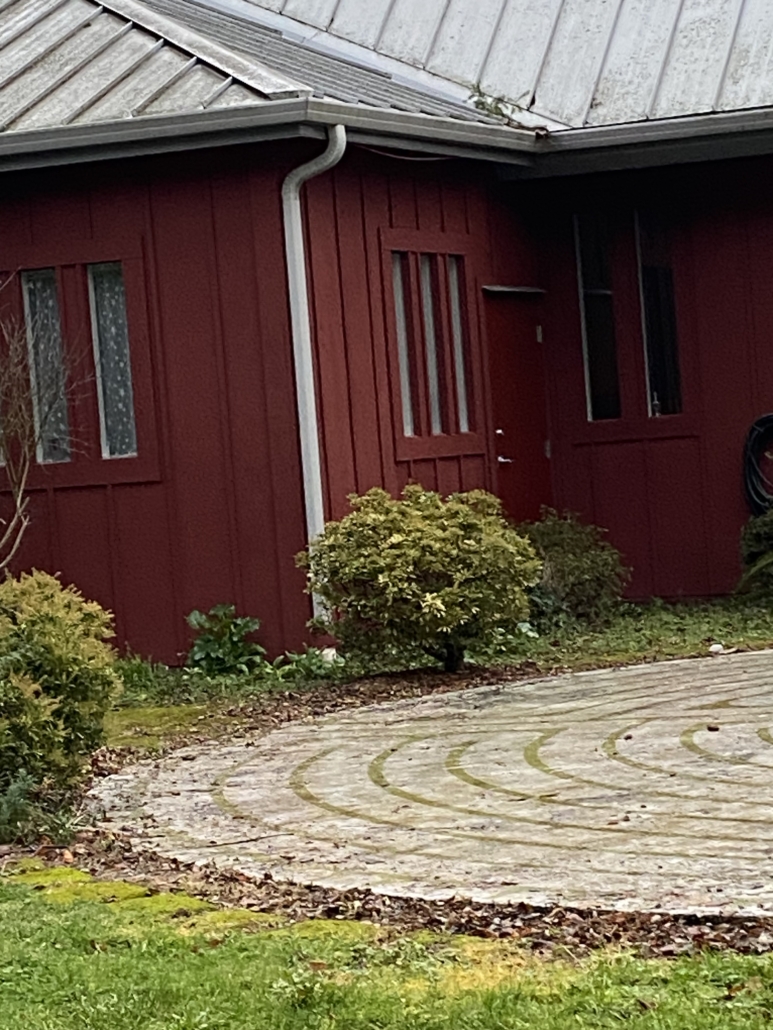
Labyrinth at St. Hilda’s / St. Patrick’s Episcopal Church

So that’s it — soon I WILL update the blog, including my list of publications. And you can expect me to be back in 2025 with more reviews of good poetry. For hard times, and for joyful times, too.

Good Poetry for Hard Times

I have mentioned my upcoming class, Good Poetry for Hard Times, to you before, and posted the announcement on my Home page with other events, but this evening I’m taking a moment to promote it again. In short:

My Creative Retirement Institute (CRI) class begins May 24 and continues for a total of four Fridays, on Zoom, 1-3:00.  As far as I know, anyone can take a CRI class (do you have to prove you’re retired? I don’t think so), and they are inexpensive.  This class is $58.

For some backstory, I first proposed to teach a Zoom poetry workshop. CRI doesn’t do craft classes, it turns out, but rather than simply say no, they asked if I would consider teaching a class about poetry, and I said yes.

The first title was Your Memorable Poem (like my workshop last year), but someone at CRI didn’t like that title. We came up with Good Poetry for Hard Times because I had been thinking a lot about Gaza, Ukraine, Nigeria…political division in our own country, mass shooti… Okay, I’m going to stop there. My thought was, Who has time to read (or write) poetry? Does the world need another poem? Shouldn’t I be doing something?

When I asked my journal that question, these are some responses my brain came up with:

1. Reading poetry (writing poetry, too) is doing something. It makes us pause and catch our breath. It can bring us joy (it definitely brings me joy).

2. A good poem, shared at the right moment, brings breath and joy and hope to the recipient, too.

3. To expand on that, poetry (all art for that matter, and joy, too) is not a luxury. We need it.

For women, then, poetry is not a luxury. It is a vital necessity of our existence … The farthest external horizons of our hopes and fears are cobbled by our poems, carved from the rock experiences of our daily lives.

—Audre Lorde

4. How is poetry a necessity? William Stafford called it a way of paying attention, and what could be more useful today than a habit of attention? Not distraction, not self-medicating. Attention.

5. Poems help make sense of loss. They are vehicles for emotion, and when we see that this poet — famous, obscure, long long dead — felt what we feel, then at the very least we feel less alone.

6. In times past, when poets retreated into the mountains (Basho, Yuanming) or into monasteries (Gerard Manley Hopkins), or into their upstairs bedroom (Emily Dickinson), what were they retreating from? How did their poetry help them to survive? (How might their poetry help us to survive our times?) Nothing too shocking or earth-shattering, but these are the questions I would like to sit with for a while.

What will each class look like?

I’m cobbling together a handout of about 50 poems that inspire me. At each session, I’ll read several poems aloud, pausing over each poem to introduce the poet, and offering context I find useful. I will also talk through what I find intriguing, healing, inspiring, memorable about each poem. Other participants (are they students if there’s no prep and no homework?) are encouraged to break in with questions or to add their comments and insights to mine. (I am HOPING people will want to talk about the poems.)

I predict that the time will fly by. So, here’s why I’m promoting it:

The class is a go, but it is slightly under-enrolled, and I’m really really hoping for a few more people. All motivations welcome:

  • The person who slept through poetry class in high school, but is ready now to see what all the fuss is about. “What’s this I hear about poetry being good for your brain?”
  • Someone who read Priscilla Long’s Dancing with the Muse in Old Age and could use an introduction to poetry before beginning his own writing practice.
  • Anyone who has been reading and writing poems for years, but, like me, finds this particular conversation timely and intriguing.

The creation of art, okay, just the attempt at the creation of art, as well as the appreciation of it, is both an enlarging of the world and an expanding of consciousness.

—Dean Young, The Art of Recklessness

If you — or someone you know — fits into any of these categories, here’s the link for CRI: https://www.edmonds.edu/programs-and-degrees/continuing-education/creative-retirement-institute/

I hope to see some of you there. White hair not required.


[I believe this link will take you directly to the course description: https://www.campusce.net/edmondsarts/Course/Course.aspx?c=1491]