Posts

Where you’ll find me…

I’m overdue for a catch-up post.

Last year, as you know, was a tough one for me. (I saw my husband twice so far this week, and he is thriving, acting as though living away from home is his new normal, happy to see me, sending me away with a list of things to procure for him. And a bagful of guilt, but you know…)
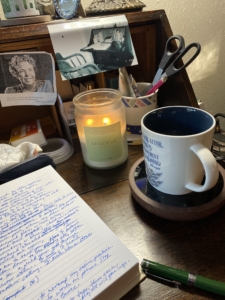
Despite last year’s drama, I assure you that I am still writing. Lots of what I write stays in my notebooks, or, at best, in rough-draft manuscripts. Yes, I did manage to review several books of poetry in 2025—but only because I was asked to (which always works with me, if you’re wondering)—and I published a few poems, because I was invited to submit to three different anthologies. I did not send out any other work. Not a glorious year, submissions-wise (not after my push in previous years to send out 100+ submissions).

One of my goals this year has been to send out my work. (Why does “submit my work to the editorial process” sound like a dodgy thing to do? “Send out” sounds more assertive.)

So I belong to a small send-out group, and when our attempt to meet once a month and report our progress seemed a complete disaster, we decided to meet once a week and for one hour hang out on Zoom together and instead of talking or moaning or whatever, to work on our send-out.

This did the trick. I’ve now managed 21 submissions of poems, reviews, stories, and essays. Not a lot, but it’s something. And I’ve had a few things accepted.

First, the on-line journal Eclectica took my poem, “Windfall Apples,” which you can find here (and which I should have mentioned some months ago).

More recently, Bracken took my poem, “Her Honeyed Mask.” Their new issue is fresh off the presses and available here. (And it’s gorgeous.)

I’ve reported previously on a couple published reviews in 2026, but my most recent review is a new one, of Anna Odessa Linzer’s new memoir, Writing Home, published by Empty Bowl Press. You can find it at https://www.ravenchronicles.org.

I’m over-the-top grateful for the editors of these publications. Given our current political culture, we cannot take their existence—or the continued existence of any of the arts—for granted. Besides which, editing a poetry journal has always been a labor of love. It’s a privilege to appear on their pages.

I’ll be back with a blog-review in the next few days. Thank you for reading!
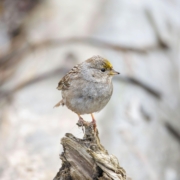
BIRDBRAINS: A LYRICAL GUIDE TO WASHINGTON STATE BIRDS

BIRDBRAINS: A LYRICAL GUIDE TO WASHINGTON STATE BIRDS, ed. Susan Rich. Raven Chronicles Press, 2025.
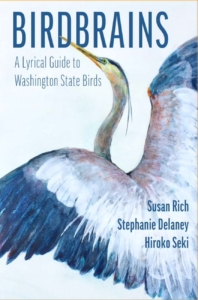
I have two poems in this lovely book, lovingly curated by Susan Rich, assisted by bird note author Stephanie Delaney and artist Hiroko Seki. The poems are narrative and lyrical, longish and very short. The poets include Martha Silano, Jayne Marek, Kevin Craft, Joannie Stangeland, Sandra Yannone, Ted Kooser, Carolyn Forché, Mary Ellen Talley, Susan Landgraf—and so many others I’ve written about in these pages. You simply have to see for yourself.

Here is one of my poems:

Golden Diva

No bigger than a puff
of dandelion fluff, round bobbin
on a bare twig, breast
of muted light, gold-daubed head,
beak and feet tucked tight,
wings wrapped against wind.

Reflected in a puddle, up-
side down, crowned
by cumulous clouds, imbiber
of dew and seeds, tiny diva,
rouged beauty hopping branch
to water, and back.

—Bethany Reid, from Birdbrains (p. 241)

Tomorrow evening (Monday, April 27, 6 p.m.), I’ll be joining several other Birdbrains contributors to read at Everett Poetry Night (The Sisters Restaurant, Grand Avenue, Everett).

P.S. This morning I came across this post from Maria Popova at The Marginalian: “The Bird that Is Your Life.” Maybe you need to read it, too.
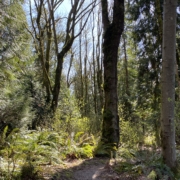
Last Call of the Dark

My review of Mary Crane’s Last Call of the Dark just went up today, on-line at Raven Chronicles. Follow the link to read the full review!

As a bonus for reading my blog, here’s a poem – about spring, which cannot get here fast enough for me.

Hazel Catkin

I greeted the first spring-like day
with exhaustion, no appreciation
of a small portion of sun
in gray mosaic, and a stiff wind.
I was tired. The retreating season
offered no space for my small needs,
as the world iced over in suspicion
and decent people passed away.

I once fell in love with a hazel catkin –
heads drawn together, breath quickened,
we gazed into its bright red styles
instead of one another’s animated faces.
I don’t need to recreate the love
but the fall – the descent into desire
as the buds swell up, the body warms,
and a blush reawakens into life.

—Mary Eliza Crane

Crane is a western Washington poet who has resided in the hills above the Snoqualmie Valley for nearly four decades. Our paths have crossed at poetry open mics in Kirkland’s Book Tree and at Easy Speak in Wedgewood (Seattle); she is a co-host of her local poetry night in Duvall. To learn more about Last Call of the Dark, see my review (of course), or visit Cirque Press.
And if you are looking for an open mic, you can find it here: Western Washington Poets Network.

Books for Writers

Before I forget, earlier this month I reviewed Martha Silano’s award-winning new book, This One We Call Ours, for Raven Chronicles. You can read the review here.


The holidays are upon us, and if you have a writer-friend, perhaps you’re wondering what book you should buy for them. Along these lines of thought, someone asked me to recommend my top 20 writing books, and I felt flummoxed. Only 20?!

What seemed more doable was to tell you about a few of the books, specifically about writing, that I’ve read this year, the ones that left the deepest footprints, the books I am most likely to reread, or to gift to my close friends.


THE WAY OF THE FEARLESS WRITER (St. Martin’s, 2022)

I stumbled across The Way of the Fearless Writer: Mindful Wisdom for a Flourishing Writing Life, by Beth Kempton, maybe in March. I picked it up, to begin with, at my local library. After a couple chapters, I ordered my own copy and returned the library’s (with a hearty recommendation to the volunteer at the desk).

In other words, I knew almost immediately that Fearless Writer was a book I had to mark up.

To write in service of the writing, not the ego, is a radical act. (p. 24)

Kempton is a Japanologist, who has also sojourned to China, and somewhere along the way met herself on the path. She invites us to do the same—not to study Japanese or the Tao Te Ching, but to embrace writing as a way of being. The passage quoted above continues:

What if we gathered up all the energy we usually spend worrying about what other people think and poured it into our writing? What if we really lived our lives, moment to moment, and wrote about that? What if we wrote to release what is burning inside us, allowing that to be enough for now? (pp. 24-25)

Kempton arranges her book around three gates (a symbol that has, for some time, spoken to me). When I reached her chapter on the gate of emptiness, my mind flew open. I was sitting in my writing cabin, my old dog snoring beside the door, but I felt, literally, as though I were poised on a threshold, about to embark on an entirely new way of being with my work. What if we wrote in service of the writing, not the ego?

It matters that I began reading this book around the time I was finishing Red Pine’s translations of Tao Yuanming’s poems, and, before I finished Fearless, I saw the Capitol Hill premier of the documentary film about Bill Porter, AKA Red Pine, Dancing with the Dead. (If you don’t know what I’m talking about, I urge you to see this film, produced by Ward Serrill, and available now on-line; I have watched it three times.) Taken together these texts—these transcendent works of art—were transforming.

(Follow this link to learn more about Beth Kempton.)


OUT OF SILENCE, SOUND. OUT OF NOTHING, SOMETHING (Counterpoint, 2023)

What can I say about this wonderful book of writing advice from Susan Griffin, one of the leading eco-feminist writers of our time? Most of the chapters are quite short. Quoted passages from other writers punctuate the author’s chapters (some of my favorites, Grace Paley, Robert Caro, Le Guin). For instance:

Storytelling is a tool for knowing who we are and what we want. (Ursula K. Le Guin, qtd. on p. 153)

Out of Silence is full of pithy advice about a writer’s work habits, words, sentences, metaphor, pauses, white space. But it’s never only pithy advice:

Creativity is more like a cat than a dog. You can’t order it to come to you. You just have to make yourself available until all of a sudden you find it leaping into your lap. (p. 55)

This sounds overly folksy, but I assure you I’ve underlined and highlighted passages on almost page. I first read this book last year, and I picked it up again in September when election anxiety was trying to do me in. Griffin is a wise, older guide, taking you by the hand, whispering, See, it doesn’t have to be fancy—it’s better if it’s not fancy!

I’ll leave you with this passage, from a chapter titled “Paragraphs”:

At times writers make [craft] choices logically but more often they come to us after immersing ourselves in the subject matter, after breathing the subject in, walking with it, sleeping on it, letting it fit into our dreams, coaxing it phrase by phrase into language. Sometimes, if we have pondered what approach to take for several hours or days or even weeks, the work starts to speak to us. (p. 106)

Let me emphasize one thread between these books. Kempton is concerned about attention: where our attention lies, how to command it, how to follow its lead. So is Griffin: “you will need to learn to pay attention to your own attention” (p. 7).

(To learn more about Susan Griffin, visit her website.)


TRUTH IS THE ARROW, MERCY IS THE BOW (Zando, 2024)

This book, by Steven Almond, was pressed on me by a friend. At first I found it … a little too … something. Casual? Comic? I liked it, well enough, but I let it get pushed aside by other books. Recently I picked it up again, and I’m so glad I did. I have called other writers and read passages aloud to them. (His stories about his children—Josie and the dread Babrika!and about reading children’s books aloud, in particular.)

But there is so much more to this book than Almond’s entertaining and no-bullshit voice (unafraid to write about how to write about sex, unafraid to chronicle his own most humiliating moments as a parent, as a teacher, as a writer). The job of the writer, he tells us, “is to love and mourn” (p. 204). This passage, which is placed at the end of the book, echoes insights threaded throughout, and says it all for me:

We are living in an era of screen addiction and capitalist pornography. As a species, we are squandering the exalted gifts of consciousness, losing our capacity to pay attention, to imagine the suffering of others. You are a part of all of this. It involves you. This is the hard labor we are trying to perform: convincing strangers to translate our specks of ink into stories capable of generating rescue. (p. 230)

What more can I add? “You are all part of this.” Writing is not a retreat or an escape from the world and your responsibility for it. What you write matters. It’s crucial.

(All three books are available at Bookshop.org, your local independent book store, and elsewhere. To learn more about Steve Almond and his books, visit his website.)