
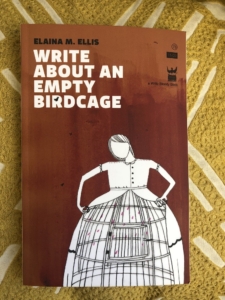
Elaina M. Ellis, WRITE ABOUT AN EMPTY BIRDCAGE

WRITE ABOUT AN EMPTY BIRD CAGE, Elaina M. Ellis, Write Bloody Publishing, 2011.

I bought this odd collection of poems by Elaina M. Ellis a few years ago, at the Chuckanut Writers Conference. Every so often I pick it up and am inspired by its bravery, its sexual bravado, and its writing prompts. The poems are arranged into 5 sections:

Write About an Empty Birdcage
Advice for the Newly Single
What I Wish for at 11:11
Write About an Ugly Animal
Welcome Back

Some of the poems are long, dense with detail, rich with the nerve it takes for a young woman in our culture (think 2011 and before) to come out and be completely herself. This short poem struck me; it’s from the first section, but I imagine the prompt as, Write about something intangible that you inherited from your family:

Heirloom

There is a loose strand of inheritance
called appetite. I have pulled it slow

from the hem of my mother’s skirt.
She is unraveled, but see—

it was not hers to begin with.
Let us pray.

Our Fathers, who emptied the shelves
so we could not get fat,

hollow be thy names. See
how I am still eating.

I have smashed down every quiet bit
of plate and glass from the cupboard.

—Elaina M. Ellis

Because I have three young (or “youngish,” at this point) daughters, each of whom has struggled in one way or another with relationships—with themselves, with others—I appreciated this book. It made me wonder if (reading through “Advice for the Newly Single”) I couldn’t challenge myself to be…braver. (Not yet.)
This poem reminded me of when my girls were young. Stuck in the car with me, if they saw the dashboard clock read 11:11, they would shout out the number, squeeze shut their eyes, and make a wish. If you shared the wish, they said, it wouldn’t come true. What did they wish for? What do I wish for?

What I Wish for at 11:11

I want
a fat blue bird
to keep me awake at night.
I want a room full of her loud
blue rustles. I want a fat blue bird
to shake and shriek her fat blue body
truly through me. I want fat
mouthfuls of feathers,
pillows stained
blue.

—Elaina M. Ellis

Learn (much) more at Artist Trust.

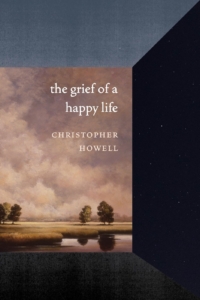
Christopher Howell, THE GRIEF OF A HAPPY LIFE

THE GRIEF OF A HAPPY LIFE, Christopher Howell, Pacific Northwest Poetry Series, University of Washington Press, 2019.

On the back cover, Kathy Fagan writes: “Howell has been for many years my go-to poet of choice when I need to be reminded of what a poem can do, what a poetry collection can do…”
I can say the same. Howell asks, in “The Giant Causes the Apocalypse,” “[W]hat will comfort us / as we hear our singing stop?” This sometimes strange, sometimes disconcerting collection of poems is an exploration of that question.

The grief in the title permeates the book, without weighing it down, like these lines from “Turnpike and Flow”:

We say it is a long road
but it is only
a life
slipping past, dark and bright, abandoning
a few broken tools and shoes, once
in a while something beautiful but too big
to carry.

Howell is truly a gem in the Washington State poetry world. He has 20 books. He teaches in the master of fine arts program at Eastern Washington University, and is an editor/director for both Lynx House Press and Willow Spring Books. Let us say he has a large and interested following. So it’s odd to find, bracketed in the middle of a long poem, these words: “[Sometimes I want you to stop / reading so I can / go on alone into the dark sublingual light…” (“Cloud of Unknowing”). I love the juxtaposition of dark with light. It’s a sentence (it’s a whole book) that takes chances.

Maybe Howell isn’t so much exploring the big questions, as urging his readers to explore them.

Here’s the final poem, which first appeared in Poetry International: 

Homecoming

I put on my good black shoes, my shirt
of grey softness that reminds me of luck,

and the blue hat given me
by a child who left

this earth that even her shadow
made so beautiful.

And then, well, I set out
down the clamor of roads

and, almost by accident, onto paths
through dense apothecaries of evergreen and fern

and finally to meadow and orchard
risen from the dead into a contentment

that did not know me
and wouldn’t take my money or my name.

Did I not see I was the same no one
who had lived there always

and could never return?
Did I not perceive the multitudes

waving their arms like wind to be known again
and gathered like pieces of a god?

How many many years, how much spent blood,
to unpilgrim ourselves, to stand before an empty house

glistening with the grief of a happy life.

—Christopher Howell

“…and after that there must be the dancing” he writes in “Surveillance.” Or, “the dancing / and the weeping / and the feast.”

You can learn more about Christopher Howell at https://www.eou.edu/mfa/faculty/christopher-howell-poetry/, or on Wikipedia and Artist Trust. I found “A Conversation with Christopher Howell” about this particular book at https://truemag.org/2018/11/08/a-conversation-with-christopher-howell/.


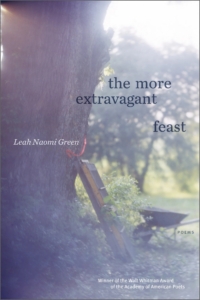
Leah Naomi Green, THE MORE EXTRAVAGANT FEAST

THE MORE EXTRAVAGANT FEAST, Leah Naomi Green, Graywolf Press, 2020. Winner of the Walt Whitman Award, 2019, selected by Li-Young Lee.

Because I have skipped a couple Aprils of my poetry-book-a-day in celebration of National Poetry Month, there’s a huge stack of poetry books waiting for my close attention. Where do all these books come from? People send me books; I exchange books with poets at readings; I pick up books in my local bookstore and can’t bring myself to put them down again; on occasion, I deliberately choose a book by a poet I don’t know—curious about the poet, or about the press.

I see each book as a sort of debt incurred, and this month is an opportunity to pay back the poetry community for supporting me.

So, where or when did I pick up this book? I don’t remember! That it was selected by Li-Young Lee (a favorite poet of mine) for this prestigious award no doubt has much to do with my having it.

Waking Up the Bell

The poem is the slag heap,
and what I keep I keep.

The axe I did not make, the trees
do what I can’t: converting light

for when it’s gone. The fire
and the forges

call the metals back
like meteorites from orbit.

The ore is that which changes me,
extracts me from myself.

The iron tonsil of the bell
I neither wrought nor swung

cleaves hours into halves,
muscles to my bone.

It scores my weeks,
spills them

one at a time
in the lap of the ferrous valley.

We’ll break them open this way,
melt them back to days.

—Leah Naomi Green

Although the poems are not what I would call Whitmanesque, each section has an epigraph from Whitman, and, like Walt Whitman’s poems, these poems celebrate and sing the body. Stiff hip, whorl of an ear, “fingers and formed lung.” Some of my favorite poems in this collection are about pregnancy and childbirth. Other poems are about introducing a child to the world, about the death of grandparents, about eating and other kinds of caring that go into sustaining our bodies.

The tenderness and simplicity of these lines in “Week Twenty: Indulgences” threw me back to my own daughters’ early childhood:

Last night
her small clothes
hung on the line waiting,
and I loved them there
all night,
their drying
in the quiet.

High praise from the back cover:

“Time doesn’t move, we move,” says Tolstoy. And so we travel—inside our bodies, inside our days, our families. Leah Naomi Green’s calm, clear eye documents the essential, elemental music of this journey. —Ilya Kaminsky

The darkness and suffering of living on earth are assumed in this work, woven throughout the fabric of its lineated perceptions and insights, and yet, it is ultimately informed by the deep logic of compassion (is there a deeper human logic?) and enacts the wisdom of desire and fecundity reconciled with knowledge of death and boundedness. —Li-Young Lee

To write poems “informed by the deep logic of compassion” is a great goal.

You can learn more about Leah Naomi Green at her website, including how to purchase her book.

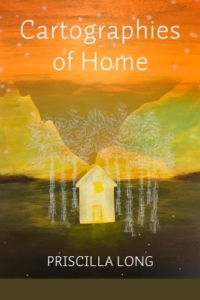
Priscilla Long, CARTOGRAPHIES OF HOME

CARTOGRAPHIES OF HOME, Priscilla Long, MoonPath Press, 2026.

Cartographies of Home, the latest collection of poems from Priscilla Long, divides the poems and her life into three sections, beginning with her childhood on the Eastern Shore of Maryland: turkey buzzards, garter snakes, molasses milk, honeysuckle.  In the middle section, the poems escort us through college, Viet Nam, Civil Rights, Greyhound bus stations, Viceroy cigarettes, banjo music. In the final section Long embraces old age. Also the author of Dancing with the Muse in Old Age, she does so with authority. She’s packed for this journey, and she knows what to do now that she’s here (write more).
I’ve been immersed in house stuff. First a bathroom remodel, then a leaky roof, stained carpets, a big leak under the kitchen cabinets, a kitchen remodel. (Those are only the highlights.) So of course I gravitated this morning to this poem:

House Bones

My old house. The small muntined window
in a step-up closet. A carpenter measuring,

cogitating, a hundred years ago. Kitchen
windows, cupboards of painted wood, fir

floorboard creaking its unforgetting.
The living-room cove ceiling curves down

to meet its molding. Mantelpiece, tiled
fireplace, the oak floor worn, telling me

I, too, am part of time; party also
to the tree felling, forest-killing

of house-making. I don’t forget stud
and beam, lintel, doorknob, latch,

and knocker. I look out single-hung sash
windows. Architect Louis Kahn said:

The window is a wonderful thing
from which you get the slice of light

that belongs to you and not the sun.
The ladder-back chair, wood-turned stile

and finial, its rush seat—Grandma Henry
owned it, sat in it. I now take my turn.

—Priscilla Long

You may have noticed that yesterday’s post also had a poem with a muntined window. Calling things by their right name is a signature feature in all Long’s writing: muntined, step-up closet, fir floorboard, living-room cove ceiling, beam, lintel, doorknob, latch. Such a pleasure!

If you’re a long-time reader of this blog, then you know I’ve visited Long’s books before. Here’s the link to her website, and a few of my earlier posts as well: Priscilla Long: HOLY MAGICThe Unsinkable Priscilla Long.

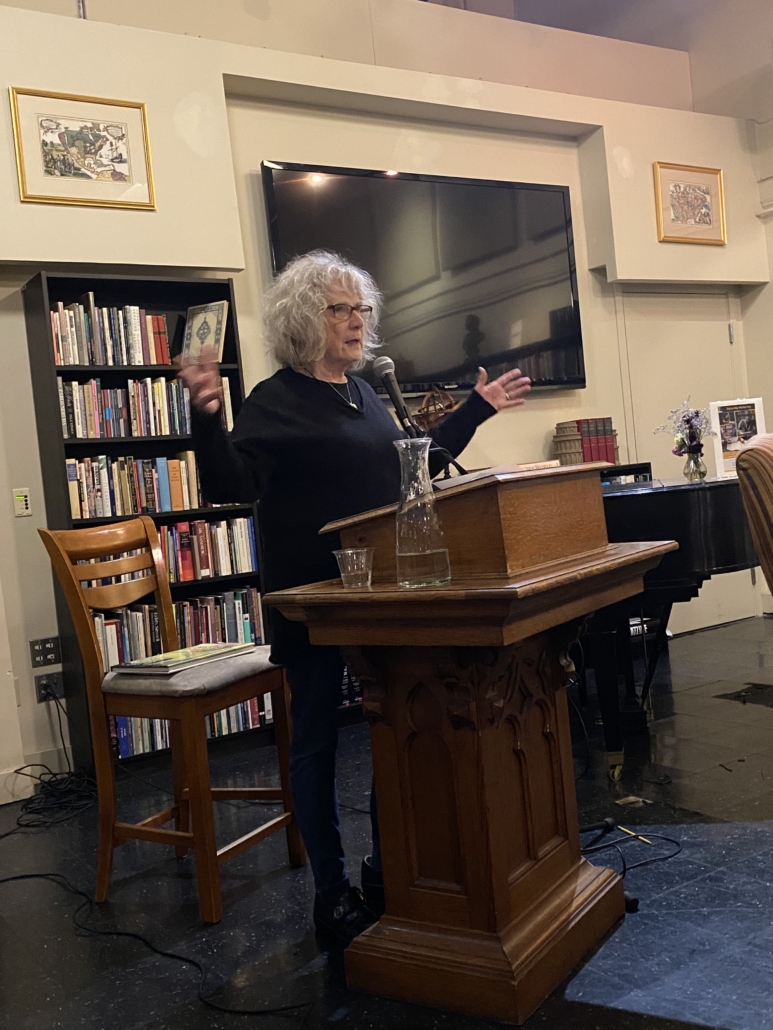
Priscilla Long at Folio, Feb. 2026