
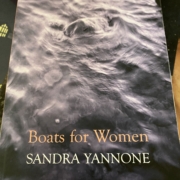
Sandra Yannone’s BOATS FOR WOMEN
BOATS FOR WOMEN, Sandra Yannone, Salmon Poetry, 2019.
If you don’t know Sandra Yannone, I am here to tell you, you really should. In addition to being Poet Laureate of her hometown, Old Saybrook, Connecticut, consider this impressive list of activities from her website:
She is co-founder and host of Cultivating Voices LIVE Poetry, an international, intersectional, intergenerational poetry group and reading series. In addition, Sandy hosts Last Tuesdays with Sandy & Thomas, a special monthly online reading event for Olympia Poetry Network subscribers, and co-hosts the West-East Bicoastal Poets of the Pandemic & Beyondonline reading series. Previous hosting and co-hosting appearances include The Collectibles Lesbian Trading Card Reading Series with Headmistress Press, and as the featured poet and collaborator on the Little Oracles: Divinations podcast miniseries.
I met up with Sandy at my June reading for Olympia Poetry Network, and we exchanged books. Her Boats for 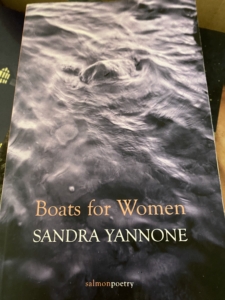 Women witnesses the sinking of the R.M.S. Titanic, rides along with Houdini’s wife, and dramatizes what it looks like to survive one’s own raucous and wild choices.
The title poem, a prose poem, marries marine history with personal history, capturing all the themes of the book—“Silence. Disaster. Desire. Hope. These cardinal directions…” Notice the anaphora (the repetition of a word at the beginning of clauses) of yes, yes, yes running all the way through the poem.
Boats for Women
Yes, the boat sank. Yes, it broke in two like a stereotypical
broken heart before it plummeted to depths no one could measure
until seventy years later technology caught up and looked its
ancestor in the face. Yes is the way the years oxidize the steel,
and yes wipes the name Titanic off the bow. Yes are the lifeboats,
the davits, the call for women and children first. Yes are the men
who cry from the decks. Sometimes when I kiss her, I am
leaving a yes on her lips to remind her that I will go down
with the ship. Sometimes when she whispers yes, she is staying
on board. But there is always room on the lifeboats for two
more women. Yes is the fact that if we were alive on that
night, we would have lived.—Sandra Yannone
If you are writing a poem a day during National Poetry Month, Sandy’s “Some Talk About Rain” suggests a good prompt. (And, yes, it is raining today in the Pacific Northwest with a 100% chance of rain.) It begins: “We were in the soggy middle again and in between / she was talking about the rain, remembering / how it rained…” A few lines later: “how we would spill / wet against the bricks, sequined trails / / rushing ahead…” Are we talking about rain or about relationships or a hike, or all three? The imagery and chimed sounds (notice the plosive sounds: weT againsT the briCKs, seQuined) here, and throughout the collection suggest, definitely, the glad all of it.
To learn more about the poet, visit her website, https://www.sandrayannone.com, where you’ll also find links to her on-line events, and for purchase of her books.
Photo from PEXELS, by Mike van Schoonderwalt: https://www.pexels.com/photo/fishing-boats-on-water-5502827/
 that she recently died. I don’t know whether to be sad or to rejoice that the world got to share this woman’s light for such a long time.