Terri Cohlene’s A CONSPIRACY OF BLACKBIRDS
A CONSPIRACY OF BLACKBIRDS, Terri Cohlene, MoonPath Press 2026.
I want to describe Terri Cohlene’s long overdue debut poetry collection, A Conspiracy of Blackbirds, as a hodge-podge, but only if you understand hodge-podge as that strange little store crammed with ancient washing machines, pitchforks, maybe a statue of Cupid or a wrought iron hen with her clutch of chicks, maybe a bag full of unexpected gems. In this collection of poems, you never know what you’ll find, and you’re sure to find exactly what you need.
Cohlene’s subjects include old photographs, old work boots, mothers, daughters, MS, bronzed baby shoes from decades 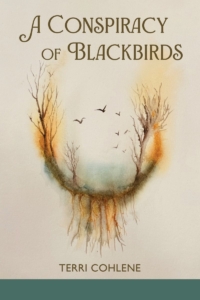 back, lost checkbooks…I could go on. As Patrick Dixon describes it: A Conspiracy of Blackbirds is “a book of surprises.” Somehow—how does she do it?—it all comes together, even the hard stuff transforming into occasions for delight. In “Finally, I Become What You Always Wanted,” addressed to the poet’s mother, we find these instructions: “Cut me open, / count the rings.” One expects such a poem to end with scars, instead—apple blossoms.
Remind me to make a copy of “On the Table” for my massage therapist. It’s a list of all the places old hurts have secreted themselves (an ex-husband, a third-grade teacher, a bully…), and ends:
Then there’s my estranged
mother, lodged like a lizard
around my sternum—
a reminder of why bones
are needed to protect the heart.
On the back cover, poet Sandra Yannone offers the perfect precis: “A Conspiracy of Blackbirds chronicles how one woman breaks free from a multi-generational cycle of abandonments to reach for the sky in a transformative murmuration of stunning flight.” Exactly so. Cohlene—an artist, children’s book writer, playwright, and more—offers a a map to the healing and sustaining power of art. These are poems that do not merely show their maker to be surviving, but with her sense of playfulness and capacity for wonder fully alive.
Tailor
If I put my mind to it,
all my poems could fit into a thimble.They are, after all, merely the alphabet,
randomly stitched together
in repeating patterns.And if I choose a font
small enough, say .05,
they would probably
slip through the eye
of a needlewith the dangle of trim,
casual embellishment
of button, bead, fringewaiting there to be discovered
by the occasional
unsuspecting elf.—Terri Cohlene
Visit Terri Cohlene’s website to learn (much) more, and to purchase her book. You can also find her book at MoonPath Press, and on bookshop.org.

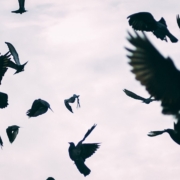
photo by Bethany Reid


 congress people, I’m getting a new roof (right now in fact, much hammering overhead), and new flooring (much needed but on hold), and dealing with a wet, rotted sub-floor in the kitchen (not sure how that’s going to turn out). I asked my therapist, “Am I going to get through this?” And she said, “You are getting through it.”