What I’m Falling For

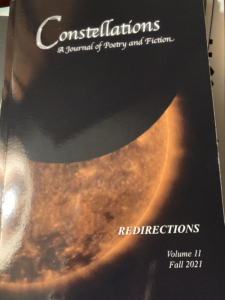
I opened the new issue of Passager (Issue 71, 2021 Poetry Contest) to find a Fall poem, and lost (or found) the next hour, reading poem after poem. It’s a wonderful issue, and I’m happy to recommend it—and not only because it includes a poem of mine.

This poem makes me think of fall, though I’m not sure that’s the season represented.

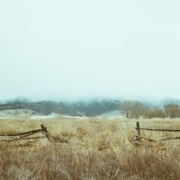
Sacred

The imprint of a perfect sphere
lies almost hidden in the bleached grasses
of this abandoned field. Each
year it seems to expand a little like a stone’s
splash in the weeds of still water.

Some call it Alien. Others the ring
around the ghost of a felled oak. Or merely
mycology, the way fungus arcs outward
from single spore. It’s the exactness

that entices. A galaxy laid flat. When
I step inside I feel the clockwise spin
and then how motion washes inward
and out again along invisible spokes. I

have never known such stillness
and radiance, abandoned like the pasture.
A necessary journey somewhere—or just here.

—Joanne M. Clarkson

Clarkson’s poem is a time-machine. Typing those words, I’m struck by how many poems are precisely that. But here it’s not just that the poem woos the past back but that the particular moment we’re invited to visit is one in which the poet steps into an enchanted circle and…goes…somewhere. Is it just that the poet has entered a “thin place,” where the past, present, and future all whirl together? In the fall of the year, it seems to me, we are especially susceptible to such places. Everything is changing. We can struggle to hang onto what we know, or we can, as someone wise once told me, “embrace the changing.”

So that’s what I’m tasking myself with. What are those slippery places in my own life where time has stopped rushing forward and held me in place to look? Or catapulted me backwards, “the clockwise spin / and then…”? When have I felt “such stillness /and radiance, abandoned…”?


The Autumn Equinox

Tomorrow — at 12:21 p.m., in my area at least — autumn begins. It seems an excellent time to write a fall poem. Here’s one that I’ve cribbed from the collection at https://www.poetryfoundation.org.

For the Chipmunk in My Yard

I think he knows I’m alive, having come down
The three steps of the back porch
And given me a good once over. All afternoon
He’s been moving back and forth,
Gathering odd bits of walnut shells and twigs,
While all about him the great fields tumble
To the blades of the thresher. He’s lucky
To be where he is, wild with all that happens.
He’s lucky he’s not one of the shadows
Living in the blond heart of the wheat.
This autumn when trees bolt, dark with the fires
Of starlight, he’ll curl among their roots,
Wanting nothing but the slow burn of matter
On which he fastens like a small, brown flame.

I am still reading Ursula K. Le Guin’s Words Are My Matter an essay each week or so — and I just came across “The Beast in the Book.” She got me thinking about animals and how we share the world with them, not very politely, and how rich children’s literature is with animals. As Le Guin puts it:

The general purpose of a myth is to tell us who we are — who we are as a people. Mythic narrative affirms our community and our responsibilities, and is told in the form of teaching-stories both to children and adults.

–Ursula K. Le Guin

Le Guin doesn’t find it at all curious that children learn to read by sounding out the words in “Peter Rabbit,” or that they weep over Black Beauty. She finds it a shame that as we grow older we lose our facility to identify with animals. I loved this paragraph, about T. H. White’s The Sword in the Stone:

Merlyn undertakes Arthur’s education, which consists mostly of being turned into animals. Here we meet the great mythic theme of Transformation, which is a central act of shamanism, though Merlyn doesn’t make any fuss about it. The boy becomes a fish, a hawk, a snake, an owl, and a badger. He participates, at thirty years per minute, in the sentience of trees, and then, at two million years per second, in the sentience of stones. All these scenes of participation in nonhuman being are funny, vivid, startling, and wise.

–Ursula K. Le Guin

I think it’s that “sentience of trees” that really made that paragraph stick for me, as I’ve also been reading Peter  Wohlleben’s The Hidden Life of Trees

My challenge for you this week is to write an autumn poem about some living being in your backyard or near environs. Like Robert Gibb’s chipmunk, how does this creature, with its small flame of wildness, teach you to be alive?

https://wdfw.wa.gov/species-habitats/species/tamiasciurus-douglasii

I don’t have chipmunks in my backyard, but we do have the small brown Douglas squirrels and the invasive, bigger gray squirrels. We sometimes have possums and raccoons; more rarely we’ve sighted deer and coyotes. Always, there are the birds: flickers, juncos, towhees, Stellar’s jays, flocks of crows each dusk. Last week, on a late walk with my dog, Pabu, I watched a flock of geese pass over, honking. The other day, my husband saw what he swears was a merlin, which is as good a sign of the changing season as any.

Where to find me

The #SealeyChallenge

Here it is, the last day of August, and already it feels like fall. Leaves are changing color, the air is cool, and this morning a light mist accompanied me on my walk. It’s a perfect day for curling up with a book of poems.

Lucky me, I’m a long-time follower of Kathleen Kirk’s blog: Wait! I have a Blog?! and all through August she’s been doing the #sealeychallenge and reading a book of poetry a day, then sharing her thoughts with us. (See this link for a LitHub introduction to The Sealey Challenge.) So I enjoyed glimpses of lots of poets and books of poetry, ordered a few new ones, and sighed with pleasure to see some old favorites.

You can catch Kathleen’s final post here: https://kathleenkirkpoetry.blogspot.com/2021/08/and-there-is-many-good-thing.html and scroll back through to read all the reviews.

But (Wait!), what’s our assignment for the week? Maybe take a quick squint at Kathleen’s August 14 review of Priscilla Long’s Holy Magic. I’m noticing this excerpt from “Indigo & Violet”:

Indigo’s deep, black before dawn.
Violet’s an evening song.
Indigo’s ex is silver,
Violet’s–obsidian.

–and it makes me think of my great-aunts whose names were Rose and Violet and Opal. Come to think of it, there was also a Pearl and a March, the latter being not a color but provocative in its own way. (And a provocative woman, too.) What if you introduced us to a color as if it were a person? Who would that person be? How would they behave?