Makes me think of Yeats: "Now that my ladder's gone / I must lie down where all the ladders start / In the foul rag and bone shop of the heart."

Taking Leave, poems by Mary Ellen Talley

I was playing around with the idea of titling a post, “What Will You Inaugurate this Year?” The idea came via my brilliant friend and piano teacher, Susan, who recently told me, Your year—your next 4 years—do not belong to any politician, they belong to you. Following this advice, however, is one of those “easier said than done” things (as a lot seems, lately).

And, as for the lofty title. I find I haven’t the heart to give anyone inspiring advice, not today. To keep it simple, a better title—maybe for my intentions this whole year—is simply, “What Bethany Is Reading Now.”

Of course I have been reading (reading has been my life-line!), but I’ve been too distracted to share on the blog. The main distraction: my 84-year-old husband fell off a ladder and down our front steps. (Throughout a hospital stay, follow up appointments, etc., he has insisted he is fine. No, he has not gotten rid of the ladders.)

Meanwhile…I had earlier committed to several local poets to review their books. Leaving aside large concepts (suggested by Latinate words such as inaugurate), spending some time on poetry sounds good. Spending a little time on the blog sounds good. So.


First up is a friend’s book, Taking Leave, by Seattle poet Mary Ellen Talley (Kelsay Books, 2024). Taking Leave is dedicated to Talley’s sister, Katherine, and to her niece, Erin, and can best be described as a series of elegies for them, but in the best tradition of the elegiac tradition, the poems do much more, bringing to life the poet’s busy mother and troubled father, family events, conversations, voices, personalities, weaving “serendipity” and “levity” through the sad times. The poet’s sister is the main character, and of course a sister twelve-years-older is—no surprise—sister, role model, cautionary tale, and other-mother.  The complexity of their relationship crescendos. “Your plumage and that glamorous smile on your face” (“Villanelle to De-Escalate”), and:

                    The last breath
doesn’t seem concrete,
but is, the leaden weight of hearts
hanging by a slender thread.

(from “Lunar Maria”)

The book is a how-to on marrying forms (palindrome, villanelle, golden shovel), playing with white space, dancing between poetry and diary-like entries. To quote Susan Rich from the back cover, Taking Leave is about “sisterhood, birds, and the cosmos.”

In this poem, about the poet’s niece, I notice how the dog and the moth anchor the opening and closing, animal-spirit guardians of a sacred space.

Messenger Under Arizona Moon

The black ‘n white mongrel, Winston,
didn’t bark or budge from his place
on the comforter as I lay next to you

watching your and my painted toes point
at the ceiling sky on a day that turned
out to be just two days before you entered

hospice. We talked of when I babysat younger you,
no mention of cancer cells or prayer. I flew home
before the gauzy moon’s final morning

crescent exit. I heard that a black moth
circled your space that day,
and touched each corner of the goodbye room

while your mother moistened your lips.
Your world slowed to a stop
as the sprite flew out your barely open window.

—Mary Ellen Talley

You can learn more about the poet at her website: https://maryellentalley.com/.

Read and write more poetry. Pay attention to what matters most to you. That’s what Mary Ellen’s poems inspire me to do.


Year’s End

It is New Year’s Eve — though this will post as January 1. Anyway, just a few thoughts to wrap up 2024 here at A Habit of Writing.

BUYING BOOKS?

Earlier this year, a reader asked me, Where do you find your books? The library, I think I said, or friends give them to me, or people send me a book with a request for a review. Thriftbooks.com is a good source when I need to purchase a book.

Well, forget that. This year I lost my mind and spent a ton of money on poetry books.

I’ve read a couple of these (see pic) — I have reviewed none.

My best excuse is that it was self-soothing behavior. Remember my spring CRI course, “Good Poetry for Hard Times”? Months ago I was already freaked out about the election, about Ukraine and Gaza, about climate change, and so on (and on).

Unsubscribing from a number of news feeds has helped. And poetry has helped. As a nutritionist once said to me, Why do we crave comfort food? Because we need comfort. At least there are no calories involved in reading poetry.

POETRY SUBMISSIONS

Not much to report this year. I began in September to send work out, but it was a half-hearted attempt and has not, so far, resulted in one single acceptance. I can report that I was invited to submit to several venues, and those poems found homes. More in 2025 when they are published.

THE POOR NEGLECTED BLOG

We will not feel too sorry for the blog — I came close to posting every week this year, and wrote a number of book reviews that appeared here, and elsewhere.

I did NOT do a good job keeping up the list of publications (see my CV tab). In March I contacted my webmaster and we made plans for new pictures, some new formatting, etc. — I had high hopes! — and then that fell flat, too. Somehow, the energy never appeared.

Voracious Reading and Writing, in General

I mean, I do after all have a Ph.D. in literature, and — from girlhood on — “reader” has always been the main listing on my calling card. So if this is my year-end brag post I should let you know I read more than poetry. I read mystery novels, of course (research!).

I also read some literary novels: Haven by Emma Donoghue, Hard by a Great Forest by Leo Vardviashvilli, Pearl by Siân Hughes (a debut novel by a poet! it took her 20 or 30 years to write! I think we might be twins separated at birth!), and Whale Fall by Elizabeth O’Connor. I reread Bring Up the Bodies by the late great Hilary Mantel. I’m happy to recommend any of these.

As for writing — that continues, every day. I am within a week or so (maybe a month) of having my second mystery novel ready for beta readers. I’ve also kept up with my poem-a-week practice. (Not that all the poems are “good” poems.) I think I’m on the verge of cobbling together the next poetry book. We will see.

TEACHING / COACHING

Now, this category, I can brag on. I worked with two poets in 2023 and 2024, and each of them has a book coming out, early in 2025. I reviewed John Egbert’s book here. I’ll review the other when I have the final ms. in my hands.

I already mentioned my first Creative Retirement Institute (CRI) class, and I am happy to report that my two proposals for 2025 courses have been accepted.

Winter quarter: “Emily Dickinson in the 21st Century”

Spring Quarter: “May Swenson and Friends”

CRI courses are inexpensive, and the whole catalog is worth a look. I highly recommend them.

My CRI offerings are sort of low-key lit courses, but I’m thinking about running my own zoom writing workshop alongside. I’ll keep the cost very low (in keeping with the doable cost of CRI courses). Contact me soon if you have a specific request about days and times.

Labyrinth at St. Hilda’s / St. Patrick’s Episcopal Church

So that’s it — soon I WILL update the blog, including my list of publications. And you can expect me to be back in 2025 with more reviews of good poetry. For hard times, and for joyful times, too.

my daughter's cat, Phillie

What Remains

Over the last few days, I’ve taken some very long walks, several naps, and I’ve read What Remains: The Collected Poems of Hannah Arendt, trans. and edited by Samantha Rose Hill with Genese Grill (LiverightPubl, 2025). It is being hailed as “a landmark literary event.” The poems, presented in the original German and in English, were never intended by Arendt for publication, and they don’t strike me as being poems one memorizes or writes out in a commonplace book. They compel, however, if taken as a diary of Arendt’s life:

The thoughts come to me,
I’m no longer a stranger to them.
I grow into their dwelling
like a plowed field.

(from Part II, 1942-1961)

If you aren’t already steeped in Hannah Arendt’s work, the footnotes and the introduction of What Remains are a necessary guide. Additionally, they offer the editors’ obsession with the poetry, and a direct look into one of the greatest minds of the 20th century.

In the introduction, Hill (a biographer of Arendt) explains that “Arendt wrote poems to record events, reflect on experiences,” but also to “engage in what she called ‘the free play of thinking.’” And it is this play of thinking that stood out to me. She was as a young woman a star student (and lover) of Martin Heidegger, but when other intellectuals embraced Naziism and Totalitarianism, she turned away in despair. I wonder to what extent her poetry kept alive her desire to be the thinker she became. Whatever the case, the paragraph describing how she carried her poems with her as she fled France, and then Europe, and came to the U. S. is worth highlighting.

As a young woman, Arendt was steeped in the German poets, and found in English writers, including W. H. Auden, Robert Lowell, Mary McCarthy, and Randall Jarrell, “her tribe.” Hill writes:

“It wasn’t that Arendt wrote poems because she was a student of poetry who was taught to write poems, or because she fancied herself a secret poet, or because she felt the muse speaking through her. Though, who is to say. Arendt wrote poems because she had found in them a language that allowed her to weave together thinking and experience.”

—Samantha Rose Hill

I am giving this book to a friend for Christmas, so in order not to mark it up I wrote many paragraphs into my morning notebook. And some of the poems found their way in, too. This line, for instance:

“We need only ignite our grief,”

If you’d like to retrace my steps, I stumbled onto this book at LitHub: https://lithub.com/snapshots-in-verse-on-hannah-arendts-long-lost-poems/

While you’re at it, look up the 2012 film, Hannah Arendt, depicting the writing of Eichmann in Jerusalem: A Report on the Banality of Evil, here: https://en.wikipedia.org/wiki/Hannah_Arendt_(film). I have an old blog post about seeing the film, and about writing and thinking more generally,

image from Pexels

By the way, I consider poets my tribe, too.

Whatever you celebrate at this darkest time of year, you are in my thoughts. Thank you for being here.


Necessary Light

It is Friday the 13th, probably too late in the day for this to post as 12/13/24, but that’s the date on which I am writing. I have been in a strange, estranged state of late. Not that I haven’t worked. At times I’ve worked obsessively. I made progress on the mystery novel, then I went back and began doing what I always do when I am anxious—rewriting pages that are already good enough.

I have not neglected my practice of writing a poem a week—as I’ve done every week since April of 2020—but the last few poems have felt like exercises. Nothing breaks out.

Rainy and windy days are especially difficult. Walking around the house, I find myself looking for where Pabu might be sleeping, find myself walking around a dog’s food dish and water dish, even though they are no longer there.

I rigorously avoid the news, then binge at 2 a.m. on political substack posts. I think it was Parker Palmer who said, “The mind awake at 2 a.m. is a deranged mind.” That would be my mind.

I decide to write down the titles of all the books I have opened and begun reading this late fall / early winter. I stop listing them when I get to 14.

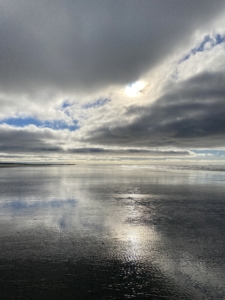
Not all of this moody circling about is unrelieved. I have kept busy. Friends gift me their extra ticket to the Pacific Northwest Ballet Nutcracker. My daughter drags me to her K-4 school’s Christmas recital. An old friend says, “I’m blue, too, let’s go to the ocean.” (And, wow, does it help.) But I come home to the same difficulties I fled.

My husband has not been well. Nothing grave—just aging. And we’ve been bickering. I want him to slow down. He wants to keep doing everything he is accustomed to doing (installing a heavy door by himself, cleaning the roof of fir needles, driving after dark, etc.). I remind him that I, too, am aging, 68 (!). He cannot bully me to hold up my end of a door I do not have the strength to hold up. (He says, “You’re not aging! You’re young!”)

It has begun growing dark by 3:45, and I remind myself that I’ve always had difficulty this time of year.

I’ve been avoiding blogging—so much for my goal to do 52 blog reviews in 2024. (For this, I forgive myself.) On the 11th, which is the anniversary of Emily Dickinson’s birth, I thought it was time, and would take my mind off my mind. Well, I’ll do it on the 12th, I told myself yesterday. And now it is the 13th.

I read a friend’s substack. She sends me to a post on Radical Acceptance, which I badly need. I see that I’m behind in reading her posts—long, personal essays that ought to be collected in a book—and so I spend the afternoon reading all of her recent posts. I wish I could write something so personal, so dense with emotion and pathos and history. I wish I dared.

What exactly is it that I’m avoiding?

Two books I have been re-reading: Edward Hirsch’s splendid How to Read a Poem (Harcourt, 1999), and Patricia Fargnoli’s Necessary Light (Utah State Univ. Press, 1999). These, perhaps more than anything, help.

“Poetry puts us on the hook [Hirsch writes]—it makes us responsible for what we might otherwise evade in ourselves and in others. It gives us great access to ourselves.”

I wrote this passage into my journal on 16 November and didn’t add the page number. For the last hour, I’ve thumbed back and forth, back and forth through the pages and can’t find it. Plucking it from my journal, retyping it for you, offers a glimmer of understanding. I begin to imagine that I could write about what’s troubling me. It’s a first step.

Meanwhile, this poem from the luminous Patricia Fargnoli:

On Hearing of the Sudden Death of a Friend

The beach bristles with dead
and beautiful things:
slipper shells washed
full of sand,
broken blue mussels,
dried rockweed and kelp;
the sand itself, not the color
I think of when I say sand,
but specks: white finer
than salt, mica-shine,
dark brown,
pepper specks of black.
Beach plums line
the grassy path to the sea,
fuchsia and white,
full of show and radiance.
I’ve set a clam shell
on my writing table,
by the window
that looks over John’s Bay.
In slow-time here,
I am learning to look closely.
The shell has a tiny hole in it,
is limed white as bone.
When someone dies,
where does all
that energy go?
Where does thought go
and attention?
Where does radiance go?
Three sailboats, anchored,
are rocking.
One fishing skiff, white, far off,
motors away from me.

—Patricia Fargnoli, Necessary Light

all photos by Bethany Reid