Posts

Two books by Lillo Way

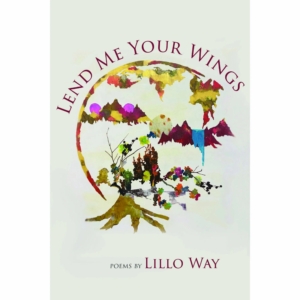
LEND ME YOUR WINGS, Lillo Way, Shanti Arts Publishing, 2021.

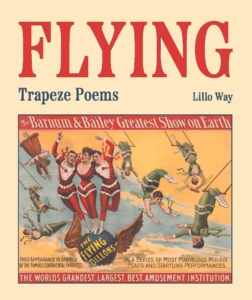
FLYING, TRAPEZE POEMS, Lillo Way, Redbird Chapbooks, 2024.

Before Lisa Ashley invited me to read with her and Lillo Way, last fall at Eagle Harbor Books, I had heard of Lillo, but had not had the privilege of meeting her or reading her work.
Lillo is named after her grandmother, stage-name Lillo Dillon (1875-1939), a trapeze artist—in a family billed as the “The Flying Dillons, Demons of the Air”—with Barnum & Bailey. The 22 poems of Flying illustrate—illuminate—the original Lillo’s life: “trained to fly,” and first put on a tight rope at age four. It’s a story that of course a granddaughter would catch onto (and no matter how her mother tried to ground her). Of course Lillo Way’s personal history is filled with acting, dancing, and choreography. And award-winning poems.

In Lend Me Your Wings the grandmother’s story also appears, but in every poem in the collection (over 100 pages), flight is interwoven with fancy. I love the sound work in these poems, and the specificity. A half-moon is framed by a window, “mullioned and muntined.” Even a poem about snoring is staged: “A bulldozer of sound. A demolition derby.” Nothing, in Lillo Way’s hands, feels ordinary. Rain in Porticello is “knives and forks frogs and ropes / halyards halberds cords and threads,” “all spangle-bangled” and falling. Clothes are tasseled and sequined, and so is memory. A performance.

Here’s one short poem to show you what I mean:

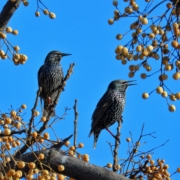
Starlets

Eighteen starlings strung along a power cable.
Sunlings, really—day birds—shining blacker
than night in the light of the longest day,
all watching the same direction, as if danger
couldn’t possibly approach from tailward.
A chorus line in a shallow proscenium theater,
each chorine staring straight downstage,
world’s shortest-legged Rockettes,
shuffling a little up or down the line.
You figure it’s the best they can do,
forgetting that their dance is all pent-up,
waiting, in the wings.

They leave the high-wire dance floor in a fugue.
A crowd of crows bursts into raucous cheers.

—Lillo Way

Having read Flying, this poem makes me think of “The Glamorous Life,” where the original Lillo shares housing with other single female performers, their half-dozen languages, their raucous laughter. Ellen Bass calls Lend Me Your Wings, “a celebration and joy,” an apt description for all of Lillo’s poems, packed tight with what lifts us: trapeze arts, beauty, dance, fire, wings, song. I invite you to take a deeper dive by visiting Lillo’s website, https://www.lilloway.com.
The Gorgeous Nothings

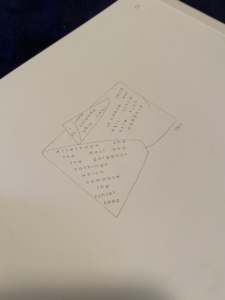
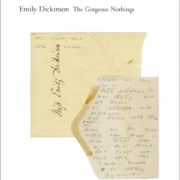
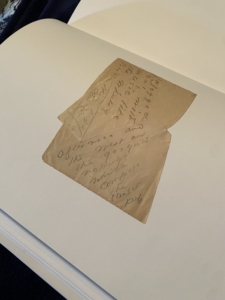
Another book I’m reading—very, very slowly—is Emily Dickinson: The Gorgeous Nothings, compiled and edited by Marta Werner and Jen Bervin. (Christine Burgin / New Directions, 2013). The work of at least twenty years for the editors, these late fragments and drafts, scribbled on envelopes and the backs of letters, come to life in this edition, “itself a work of art,” as Susan Howe writes in the preface. It’s the next best thing to sitting in an archive and handling the actual materials that Dickinson touched.

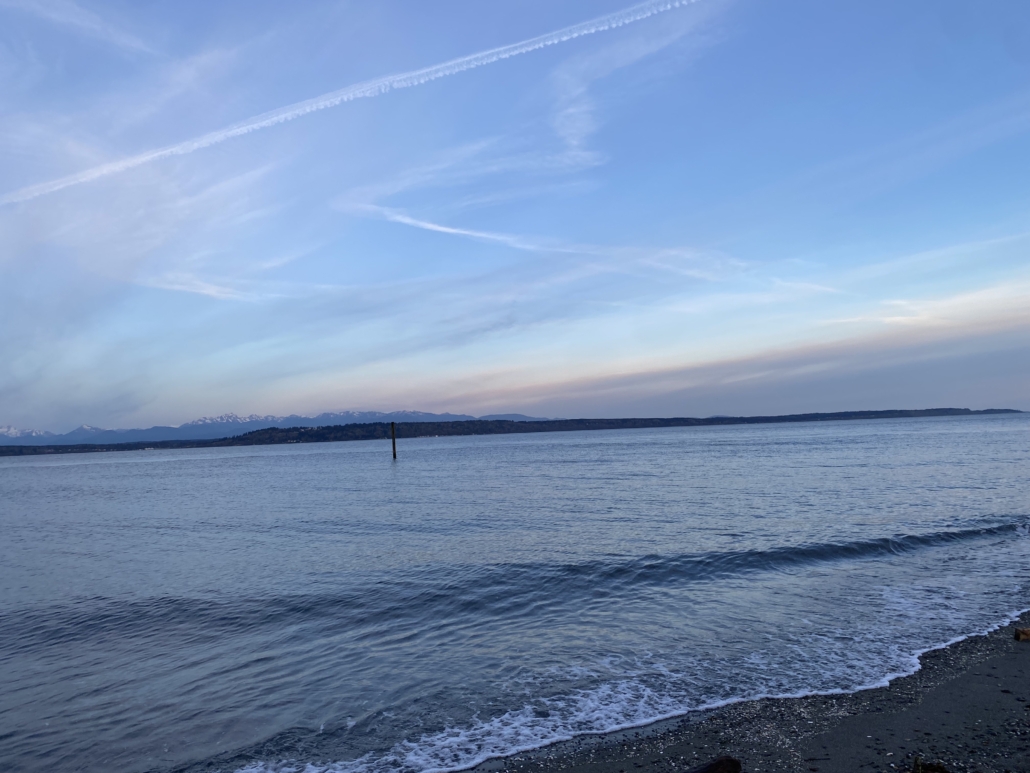
I attended a sunrise service this morning, and standing on a beach at dawn made me think of Dickinson and her “gorgeous nothings.” It makes me happy to be able to share it with you.

Gregory Orr, image from Copper Canyon

poetry will save you

POETRY AS SURVIVAL, Gregory Orr, University of Georgia Press, 2002.

In the depths of a blues my husband used to call “the Dempsey Dumpster,” I had a dream, or a fragment of dream that woke me in the winter dark, and this single line struck me and stuck with me, long after the details of the dream had vanished:

poetry will save you

I don’t feel too saved, not yet, but I have been reading a book, Gregory Orr’s Poetry as Survival, unearthed from stacks of unread books beside my desk, and I’m finding it helpful.

My goal during National Poetry Month is to post every day—to inspire you every day—but that won’t necessarily mean a review (I’m currently reading a friend’s 100-page poetry collection). But it could mean…something. So here’s a fragment from the great Gregory Orr:

On a day-to-day basis our threshold is constantly shifting and disappearing and being repressed out of anxiety, whereas in poetry we seek out poems that can take us to our threshold (or one of our thresholds). It is just such a place where we feel most alive, where both exchange of energy and change itself can happen. It is on a threshold, at the edge, where we are most able to alter our understanding of the world and our lives in it. (53)

I’m discovering, too, Orr’s delightful images:

It’s possible to imagine the rectangle of a doorway as the rectangular shape of the page on which a poem appears. (52)

Meanings in symbol are like the twenty circus clowns emerging from a tiny car, and we are well advised to yield to the naïve wonder of such abundance. (104)

In yesterday’s post I was tempted to use the clown car trope to describe Kathleen Flenniken’s dexterity with layers (upon layers) of meaning. I should have.
So, there you have it. I’m accompanying my dear friend Priscilla Long to Book Tree this afternoon (4ish?) for her workshop and reading, and I will be reading on the open mic. You could read on the open mic, too.

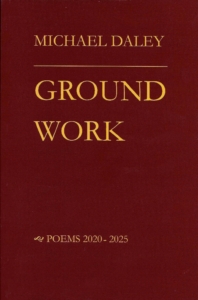
Michael Daley, GROUND WORK

GROUND WORK: POEMS 2020-2025, Michael Daley, Ravenna Press 2025

It’s my pleasure today to share a poem from Michael Daley’s newest book, Ground Work. My full review appears in the current print edition of Rain Taxi, and you can learn more about Michael by visiting his page at Empty Bowl, or Poets & Writers. (My on-line search for sites to share with you yielded numerous Michael Daley interviews, poems, and recordings.)

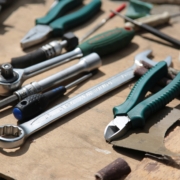
I love this poem (below) because I, of late, have been in danger of being buried in the bottom of a toolbox. House projects began piling up in December—new gutters turned into a new roof, delayed and expanded by the discovery of rotted roof struts; new flooring because of the damaged carpets revealed a leak in the kitchen, a subfloor that had to be replaced, then the perhaps stupid choice to go for a whole new kitchen; and did I mention the doors, the windows?—suffice to say we are not yet at the end. (Though now when things come up I am learning to say, “That’s a 2027 problem.”)

Rereading Michael’s poems about work, and about failed work, gives me heart.

On the Gift of Yet Another Torn Cardboard Box of the Late Great Master Poet’s Letters

For Fred Manvellor

Maybe fifty years from now, some kid mechanic
desperate to locate a caulking gun or jigsaw blade
inside a greased box labeled “finest bourbons”—
under a cache of stripped screws, bent brads,
cigarette butts, garage soot, crumpled bloodied toilet tissue—
might uncover such a trove of my own unread sketches, unsent letters,
drafts of failed poems, and dreams—if I’m lucky.

—Michael Daley, Ground Work

Nina Burokas, in her Raven Chronicles review, calls the poems of Ground Work, “incantatory,” and adds a timely reminder (for me) that all work (house repairs as well as the writing or poetry reviews) is prayer.

Michael Daley is truly a northwest treasure and I invite you to take a deeper look.