
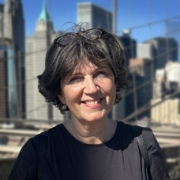
Kathleen Flenniken, DRESSING IN THE DARK
DRESSING IN THE DARK, Kathleen Flenniken, Lynx House Press, 2025.
A new book of poems by Kathleen Flenniken is always a cause for rejoicing.
The latest addition to the prestigious Pacific Northwest Poetry Series, edited by Linda Bierds, Dressing in the Dark 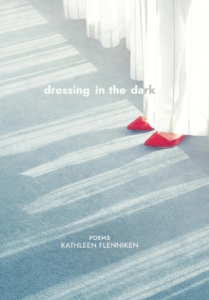 is a paean to memory, loss, and survival. Flenniken has arranged thirty-nine poems into three sections, each section headed by a line from Theodore Roethke’s “The Waking,” and it’s easy to understand this book as a wake-up call. Here is your life, the poet urges us, wake up, live it.
The book begins with a diagnosis of breast cancer. Alhough themes of childhood, motherhood, and marriage are interwoven, Flenniken does not shy away from diagnosis, surgery, and after, instead unfolding layers of meaning from what she no longer has. “In My Hand,” begins:
When the breast is taken
what remains is not unfelt
but unfeeling. Unable to speak.
With the repeated n sounds (including the powerful un-, un-, un-), ending with the harsh sound of “speak,” this could be a three-line poem in itself. But Flenniken continues, packing in marriage, marital conflict, the marriage bed—lines that made me want to weep (“touch can be like conversation”)—and ends:
I can cup the silence in my hand
and feel its warmth
the way anyone touching me could.
The powerful evocation of feeling is everywhere present here. We can be haunted by our losses, or we can hold them.
Here is one poem for you—though I could have chosen any, a whole book of new favorites.
61
I remember myself as my own child
pinned at the chest to a list of wishes.
This isn’t the way I expected her to turn out.I confused my inside and outside,
chose to be inscribed and circumscribed.What would it mean to embrace myself?
my hands holding hands, packages, keys.Balance required me to concentrate
on the doorknob, the groceries.For much of my life I wanted to feel denied—
the principle of the grapefruit diet, of Odysseuslashed to the mast while the sirens sang.
I trained on half-price racks of turtleneck sweaters.We speak of ambition, the chef instead of the cook,
but Mother sat at a tablewriting Christmas card after Christmas card
four days running every year.Then she made the lebkuchen, shortbread,
and fruit cake. The true listenerdoesn’t distinguish inside from outside.
She counts them the same. Bird songand whatever you still could be.
You can find five more poems from Dressing in the Dark at New World Writing Quarterly.
Kathleen was Poet Laureate of Washington State from 2012-2014. Visit her website to learn more about her. Order her books at bookshop.org or your local independent bookshop.
 book?
book?