
Christopher Howell, THE GRIEF OF A HAPPY LIFE
THE GRIEF OF A HAPPY LIFE, Christopher Howell, Pacific Northwest Poetry Series, University of Washington Press, 2019.
On the back cover, Kathy Fagan writes: “Howell has been for many years my go-to poet of choice when I need to be 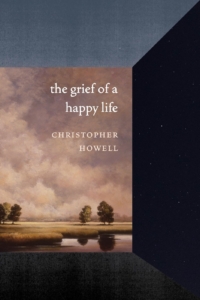 reminded of what a poem can do, what a poetry collection can do…”
I can say the same. Howell asks, in “The Giant Causes the Apocalypse,” “[W]hat will comfort us / as we hear our singing stop?” This sometimes strange, sometimes disconcerting collection of poems is an exploration of that question.
The grief in the title permeates the book, without weighing it down, like these lines from “Turnpike and Flow”:
We say it is a long road
but it is only
a life
slipping past, dark and bright, abandoning
a few broken tools and shoes, once
in a while something beautiful but too big
to carry.
Howell is truly a gem in the Washington State poetry world. He has 20 books. He teaches in the master of fine arts program at Eastern Washington University, and is an editor/director for both Lynx House Press and Willow Spring Books. Let us say he has a large and interested following. So it’s odd to find, bracketed in the middle of a long poem, these words: “[Sometimes I want you to stop / reading so I can / go on alone into the dark sublingual light…” (“Cloud of Unknowing”). I love the juxtaposition of dark with light. It’s a sentence (it’s a whole book) that takes chances.
Maybe Howell isn’t so much exploring the big questions, as urging his readers to explore them.
Here’s the final poem, which first appeared in Poetry International:
Homecoming
I put on my good black shoes, my shirt
of grey softness that reminds me of luck,and the blue hat given me
by a child who leftthis earth that even her shadow
made so beautiful.And then, well, I set out
down the clamor of roadsand, almost by accident, onto paths
through dense apothecaries of evergreen and fernand finally to meadow and orchard
risen from the dead into a contentmentthat did not know me
and wouldn’t take my money or my name.Did I not see I was the same no one
who had lived there alwaysand could never return?
Did I not perceive the multitudeswaving their arms like wind to be known again
and gathered like pieces of a god?How many many years, how much spent blood,
to unpilgrim ourselves, to stand before an empty houseglistening with the grief of a happy life.
—Christopher Howell
“…and after that there must be the dancing” he writes in “Surveillance.” Or, “the dancing / and the weeping / and the feast.”
You can learn more about Christopher Howell at https://www.eou.edu/mfa/faculty/christopher-howell-poetry/, or on Wikipedia and Artist Trust. I found “A Conversation with Christopher Howell” about this particular book at https://truemag.org/2018/11/08/a-conversation-with-christopher-howell/.
 Much of it good: carpet edge is reset; electrician has rewired for the new stove and installed the light fixture over the sink; faucet and garbage disposal going in today; appliances, soon. (It looks as though I will have a working kitchen again within 2 or 3 days, early next week at the latest.)
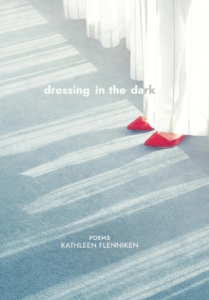 is a paean to memory, loss, and survival. Flenniken has arranged thirty-nine poems into three sections, each section headed by a line from Theodore Roethke’s

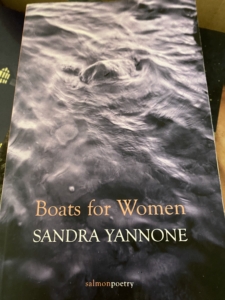 Women witnesses the sinking of the R.M.S. Titanic, rides along with Houdini’s wife, and dramatizes what it looks like to survive one’s own raucous and wild choices.