
Tony Hoagland (1953-2018)
TURN UP THE OCEAN: POEMS, Tony Hoagland. Graywolf Press, 212 Third Avenue North, Suite 485, Minneapolis, Minnesota 55401, 2022, 85 pages, $16 paper, www.graywolfpress.org.
I can’t resist the temptation—after the last poem in yesterday’s blogpost—to read and share Tony Hoagland’s posthumous collection, Turn Up the Ocean. Not to have every blogpost an elegy, but if you want to read more about him, you could start with the New York Times obituary, which includes a link to Hoagland reading his poem, “Romantic.”
Tony Hoagland is another poet I have been reading for decades. Not so much for insight into my personal life, as for insight into our times. For insight and for humor—for a wry, often biting (“mordant”) humor. Or this definition, from Hoagland himself:
“Humor in poetry is even better than beauty. If you could have it all, you would, but humor is better than beauty because it doesn’t put people to sleep. It wakes them up and relaxes them at the same time.” (from NYT obit, cited above)
Does Hoagland’s humor relax us? Consider the opening of “Gorgon”: “Now that you need your prescription glasses to 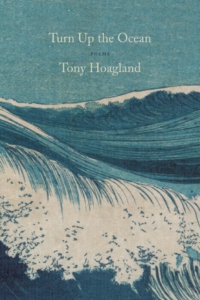 see the stars / and now that the telemarketers know your preference in sexual positions. // Now that corporations run the government…”
No matter. Even in poems such as “The Reason He Brought His Gun to School: A Blues,” and “Squad Car Light” (“the officers—so much gear attached to them, / they clank when they walk—the spurs and handcuffs / hung from their belts, / the slender baton for administering shock”), I am right there with him, wide awake, eager to read more.
Or lines such as this, from “Among the Intellectuals”:
They passed the days in an activity they called “thought-provoking,”
as if thought were an animal, and they used long sticksto poke through the bars of its cage,
tormenting and arousing thinking into strange behaviors.
We should thank Hoagland’s wife, Kathleen Lee, for this beautiful, sometimes raw book. In her brief afterword she writes that Hoagland before his death “gathered a group of poems—recent and older—into what he imagined as a chapbook” (p. 83). Lee expanded the collection in 2020, explaining:
“Tony revised his manuscripts almost as much as he revised poems; he felt any version might be good enough, but none exactly right. No doubt he would want to make changes to some of the these poems and to this published version of Turn Up the Ocean.“
I wonder if some of the poems about his illness and dire prognosis are in that category of late-additions to the manuscript, and I’m so glad Lee put them there. (See for instance “Why I Like the Hospital,” “Reading While Sick in the Middle of the Night,” or “Siberia,” which begins: “In these final few months of my life, / I feel a little like a Russian poet / who’s been exiled to a remote / village in Siberia….”)
While I’m at it, I want to recommend Hoagland’s books of prose: Real Sofistikashun (2006), Twenty Poems that Could Save America and Other Essays (2014), and The Art of Voice: Poetic Principles and Practice (2020). For a sample essay, and a poetry tutorial (!), “Image Out of Sound,” visit Graywolf Press, here.
I never studied with Hoagland, but I am told that he was a generous and encouraging teacher (with a razor-sharp wit). His poems, I know, are generous, inclusive and provocative:
Virginia Woolf
On mornings like this I often think of her
lying in bed all day in her pajamas,
the room striped in sunlight and cats
like a painting by Matisse.Virginia writing newsy letters to her friends:
“The light through fog is convalescent,” she said,
and “The main requirement for public life
is overacting.”On a morning like this,
when I walk the fields behind the house,
I feel that she is still alive,
sipping from her second pot of tea,
notebook propped up on her knees—nose deep in language
like a thoroughbred horse,
like an endangered species
brought back from extinction.I think of her and
I would like to know she is all right,
though I know she suffered terribly
from too much sight.But who will talk to the petunias now
on Finchley Lane? Who will stand
and look out of the window for hours?
who will tell the sunlight
not to be so vain?Who will inform the piece of toast
on the small blue plate
with one bite taken out of itthat she will not be coming back?
—Tony Hoagland

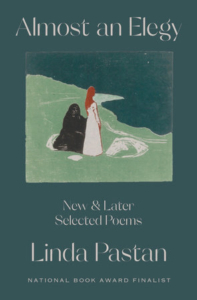 Pastan didn’t write poems when her children were small—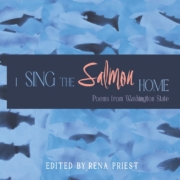
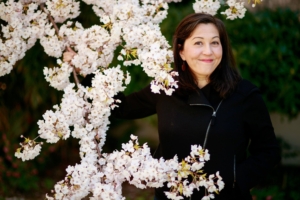 Washington State Poet Laureate) has selected 167 poems as varied as wild salmon themselves. The section titles give us a clue to the contents: “Wild, Sacred,” “Sojourn,” “Invisible Thread,” “Fish School,” “Gratitude,” “Choices,” “Vigil,” “What We Owe.” With a preface from Priest herself, and an introduction by Empty Bowl co-publisher