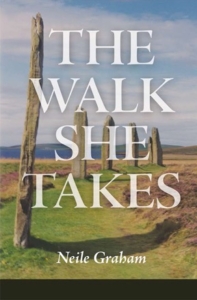
Neile Graham, THE WALK SHE TAKES

THE WALK SHE TAKES, Neile Graham, MoonPath Press, 2019.

This morning I took a walk across Scotland—and across several centuries—with Neile Graham. She reminded me of something I was told when I visited Chartres Catheral: don’t travel as a tourist, but as a pilgrim. “Why did I leave my shore for another?,” Graham asks in “Atlantic Pacific.” This collection of poems answers that question.
In this excerpt, I don’t know if she is referring to the black dog of depression, but that’s how it resonates with me:

I dare the black dog

to rise out of my bones, out of the shadows
to flicker fey at the edge of my vision.

Offer a vision. Mine/yours/another’s.
Driving along the winding coastline,

marking the bends of the sea
as it shapes the land…

The place names create much of the pleasure here: Machrie Moor, Smailholm Tower, Lockerbie, Inchcolm Abbey, Ring of Brodgar, Kilmichael Glassary. And the unapologetic use of Scots, some familiar, some not: kail yard, cruisie, cottar, cairn. But Graham’s own gift for language, for image, for color, makes up the rest. As in this poem:

Kilchurn Castle Picturesque

Rough waters: steel-blue, white-capped
like the clouds above. Low hills raise the sky,
shade up to hunter green, sage green,
then misty mountain blue. A storybook view
across the loch to where Kilchurn nestles at its edge
etched out against the loch like a hill itself.
Closer, and towers define themselves,
windows yaw and gape,
chimneys dagger a path to the sky.

Above the doorway: 1693 and crowns. A shield.
Ropes twined like snakes and Celtic knottery.
We climb and duck. I pose,
surprised in an archway. A fallen turret
the plinth for a statue my now-dead father becomes,
my mother laughing at us, she who now
has forgotten her life. In my camera Kilchurn’s light
sears this instant into history, true beauty:
grey stone and a span of grace.

—Neile Graham

I have a handful of travel poems myself, and have never known how to weave them into the tapestry of a book. Neile Graham has the answer—stay longer, write more. “When a mile-long walk can take you 5000 years” (“Westness Walk: Rousay”), then why not?

Graham is Canadian-born but a long resident of Seattle. I am claiming her as a kindred spirit. Learn more at MoonPath Press or at her website (lots of links to more poetry): https://neilegraham.com.

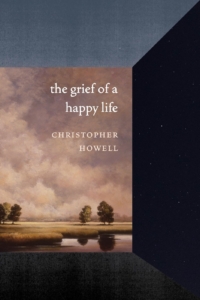
Christopher Howell, THE GRIEF OF A HAPPY LIFE

THE GRIEF OF A HAPPY LIFE, Christopher Howell, Pacific Northwest Poetry Series, University of Washington Press, 2019.

On the back cover, Kathy Fagan writes: “Howell has been for many years my go-to poet of choice when I need to be reminded of what a poem can do, what a poetry collection can do…”
I can say the same. Howell asks, in “The Giant Causes the Apocalypse,” “[W]hat will comfort us / as we hear our singing stop?” This sometimes strange, sometimes disconcerting collection of poems is an exploration of that question.

The grief in the title permeates the book, without weighing it down, like these lines from “Turnpike and Flow”:

We say it is a long road
but it is only
a life
slipping past, dark and bright, abandoning
a few broken tools and shoes, once
in a while something beautiful but too big
to carry.

Howell is truly a gem in the Washington State poetry world. He has 20 books. He teaches in the master of fine arts program at Eastern Washington University, and is an editor/director for both Lynx House Press and Willow Spring Books. Let us say he has a large and interested following. So it’s odd to find, bracketed in the middle of a long poem, these words: “[Sometimes I want you to stop / reading so I can / go on alone into the dark sublingual light…” (“Cloud of Unknowing”). I love the juxtaposition of dark with light. It’s a sentence (it’s a whole book) that takes chances.

Maybe Howell isn’t so much exploring the big questions, as urging his readers to explore them.

Here’s the final poem, which first appeared in Poetry International: 

Homecoming

I put on my good black shoes, my shirt
of grey softness that reminds me of luck,

and the blue hat given me
by a child who left

this earth that even her shadow
made so beautiful.

And then, well, I set out
down the clamor of roads

and, almost by accident, onto paths
through dense apothecaries of evergreen and fern

and finally to meadow and orchard
risen from the dead into a contentment

that did not know me
and wouldn’t take my money or my name.

Did I not see I was the same no one
who had lived there always

and could never return?
Did I not perceive the multitudes

waving their arms like wind to be known again
and gathered like pieces of a god?

How many many years, how much spent blood,
to unpilgrim ourselves, to stand before an empty house

glistening with the grief of a happy life.

—Christopher Howell

“…and after that there must be the dancing” he writes in “Surveillance.” Or, “the dancing / and the weeping / and the feast.”

You can learn more about Christopher Howell at https://www.eou.edu/mfa/faculty/christopher-howell-poetry/, or on Wikipedia and Artist Trust. I found “A Conversation with Christopher Howell” about this particular book at https://truemag.org/2018/11/08/a-conversation-with-christopher-howell/.


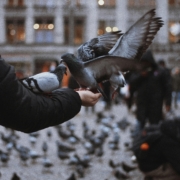
Photo by Emine: https://www.pexels.com/photo/pigeons-on-person-s-hand-15010957/

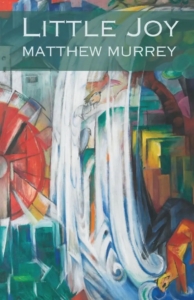
Matthew Murrey, LITTLE JOY

I’m really phoning it in today—my apologies. It’s been one of those days (2 days) with a thousand interruptions. Much of it good: carpet edge is reset; electrician has rewired for the new stove and installed the light fixture over the sink; faucet and garbage disposal going in today; appliances, soon. (It looks as though I will have a working kitchen again within 2 or 3 days, early next week at the latest.)

A month or so ago I reviewed Matthew Murrey’s book, Little Joy (from The Portage Poetry Series, Cornerstone Press, 2026) for Escape Into Life. You can read my review by following this link.

And here is one poem, to demonstrate what I mean about the delight Murrey threads through the entire book:

Shifting

I was wind and sunlight again
on the El platform as a train pulled in.

Its doors opened to a woman
with wild, gray hair and loose layers

of mismatched clothes. Without one word
she tossed a blessing of birdseed for the birds

then pigeoned back from the closing doors.
I could call her crazy, but what about you and me

shifting for ourselves in our drabs and grays that hide
our iridescent purple and green fly-away dreams?

I wish I could wear my wings on my sleeve, even as I grub
for the money that gets me the food I need and the place I sleep.

—Matthew Murrey, Little Joy

Think of Rainer Maria Rilke’s “Archaic Torso of Apollo,” with its resounding end-line, “You must change your life.” Rilke closely observes a statue; Murrey, an old woman feeding birds. If you need a prompt today, take note of two or three things—unusual, maybe—that catch your attention today. Jot down some details from one, and, dwelling on it, consider what you might change about your own life in answer to its call.

Priscilla Long, CARTOGRAPHIES OF HOME

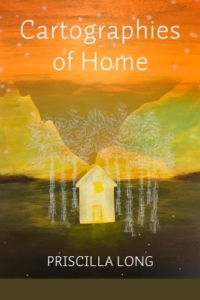
CARTOGRAPHIES OF HOME, Priscilla Long, MoonPath Press, 2026.

Cartographies of Home, the latest collection of poems from Priscilla Long, divides the poems and her life into three sections, beginning with her childhood on the Eastern Shore of Maryland: turkey buzzards, garter snakes, molasses milk, honeysuckle.  In the middle section, the poems escort us through college, Viet Nam, Civil Rights, Greyhound bus stations, Viceroy cigarettes, banjo music. In the final section Long embraces old age. Also the author of Dancing with the Muse in Old Age, she does so with authority. She’s packed for this journey, and she knows what to do now that she’s here (write more).
I’ve been immersed in house stuff. First a bathroom remodel, then a leaky roof, stained carpets, a big leak under the kitchen cabinets, a kitchen remodel. (Those are only the highlights.) So of course I gravitated this morning to this poem:

House Bones

My old house. The small muntined window
in a step-up closet. A carpenter measuring,

cogitating, a hundred years ago. Kitchen
windows, cupboards of painted wood, fir

floorboard creaking its unforgetting.
The living-room cove ceiling curves down

to meet its molding. Mantelpiece, tiled
fireplace, the oak floor worn, telling me

I, too, am part of time; party also
to the tree felling, forest-killing

of house-making. I don’t forget stud
and beam, lintel, doorknob, latch,

and knocker. I look out single-hung sash
windows. Architect Louis Kahn said:

The window is a wonderful thing
from which you get the slice of light

that belongs to you and not the sun.
The ladder-back chair, wood-turned stile

and finial, its rush seat—Grandma Henry
owned it, sat in it. I now take my turn.

—Priscilla Long

You may have noticed that yesterday’s post also had a poem with a muntined window. Calling things by their right name is a signature feature in all Long’s writing: muntined, step-up closet, fir floorboard, living-room cove ceiling, beam, lintel, doorknob, latch. Such a pleasure!

If you’re a long-time reader of this blog, then you know I’ve visited Long’s books before. Here’s the link to her website, and a few of my earlier posts as well: Priscilla Long: HOLY MAGICThe Unsinkable Priscilla Long.

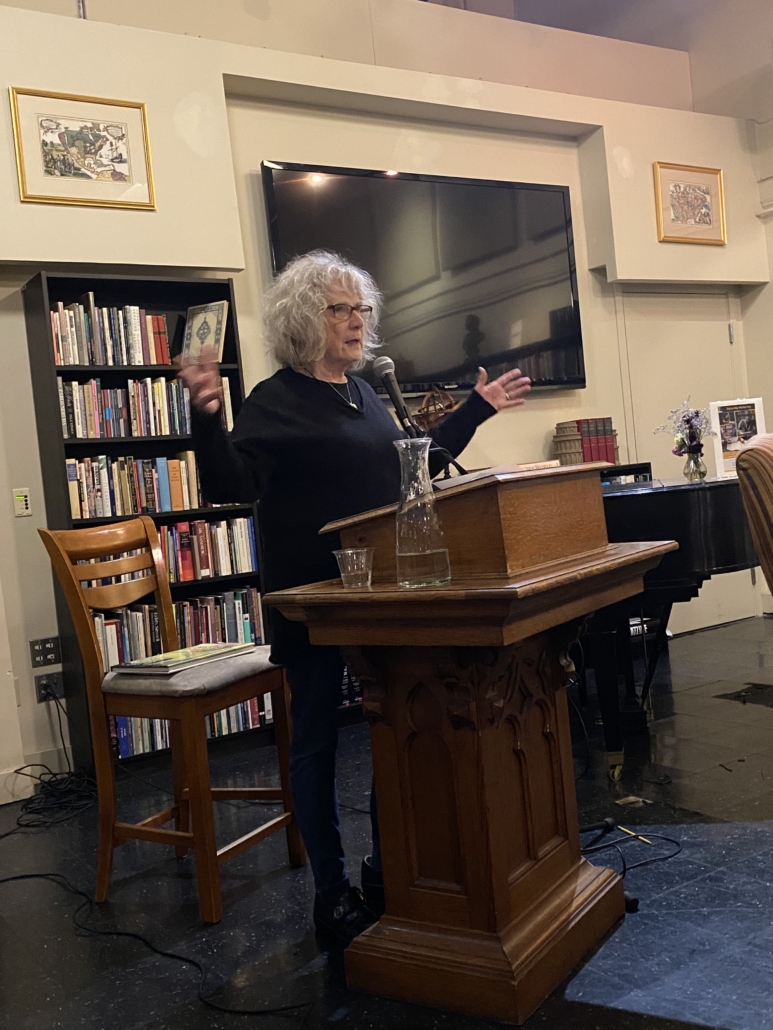
Priscilla Long at Folio, Feb. 2026