Posts

Neile Graham, THE WALK SHE TAKES

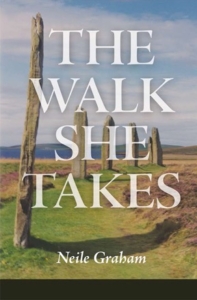
THE WALK SHE TAKES, Neile Graham, MoonPath Press, 2019.

This morning I took a walk across Scotland—and across several centuries—with Neile Graham. She reminded me of something I was told when I visited Chartres Catheral: don’t travel as a tourist, but as a pilgrim. “Why did I leave my shore for another?,” Graham asks in “Atlantic Pacific.” This collection of poems answers that question.
In this excerpt, I don’t know if she is referring to the black dog of depression, but that’s how it resonates with me:

I dare the black dog

to rise out of my bones, out of the shadows
to flicker fey at the edge of my vision.

Offer a vision. Mine/yours/another’s.
Driving along the winding coastline,

marking the bends of the sea
as it shapes the land…

The place names create much of the pleasure here: Machrie Moor, Smailholm Tower, Lockerbie, Inchcolm Abbey, Ring of Brodgar, Kilmichael Glassary. And the unapologetic use of Scots, some familiar, some not: kail yard, cruisie, cottar, cairn. But Graham’s own gift for language, for image, for color, makes up the rest. As in this poem:

Kilchurn Castle Picturesque

Rough waters: steel-blue, white-capped
like the clouds above. Low hills raise the sky,
shade up to hunter green, sage green,
then misty mountain blue. A storybook view
across the loch to where Kilchurn nestles at its edge
etched out against the loch like a hill itself.
Closer, and towers define themselves,
windows yaw and gape,
chimneys dagger a path to the sky.

Above the doorway: 1693 and crowns. A shield.
Ropes twined like snakes and Celtic knottery.
We climb and duck. I pose,
surprised in an archway. A fallen turret
the plinth for a statue my now-dead father becomes,
my mother laughing at us, she who now
has forgotten her life. In my camera Kilchurn’s light
sears this instant into history, true beauty:
grey stone and a span of grace.

—Neile Graham

I have a handful of travel poems myself, and have never known how to weave them into the tapestry of a book. Neile Graham has the answer—stay longer, write more. “When a mile-long walk can take you 5000 years” (“Westness Walk: Rousay”), then why not?

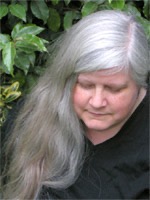
Graham is Canadian-born but a long resident of Seattle. I am claiming her as a kindred spirit. Learn more at MoonPath Press or at her website (lots of links to more poetry): https://neilegraham.com.

Priscilla Long, CARTOGRAPHIES OF HOME

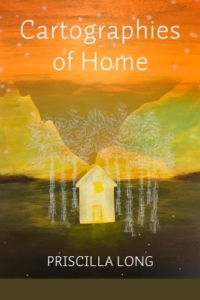
CARTOGRAPHIES OF HOME, Priscilla Long, MoonPath Press, 2026.

Cartographies of Home, the latest collection of poems from Priscilla Long, divides the poems and her life into three sections, beginning with her childhood on the Eastern Shore of Maryland: turkey buzzards, garter snakes, molasses milk, honeysuckle.  In the middle section, the poems escort us through college, Viet Nam, Civil Rights, Greyhound bus stations, Viceroy cigarettes, banjo music. In the final section Long embraces old age. Also the author of Dancing with the Muse in Old Age, she does so with authority. She’s packed for this journey, and she knows what to do now that she’s here (write more).
I’ve been immersed in house stuff. First a bathroom remodel, then a leaky roof, stained carpets, a big leak under the kitchen cabinets, a kitchen remodel. (Those are only the highlights.) So of course I gravitated this morning to this poem:

House Bones

My old house. The small muntined window
in a step-up closet. A carpenter measuring,

cogitating, a hundred years ago. Kitchen
windows, cupboards of painted wood, fir

floorboard creaking its unforgetting.
The living-room cove ceiling curves down

to meet its molding. Mantelpiece, tiled
fireplace, the oak floor worn, telling me

I, too, am part of time; party also
to the tree felling, forest-killing

of house-making. I don’t forget stud
and beam, lintel, doorknob, latch,

and knocker. I look out single-hung sash
windows. Architect Louis Kahn said:

The window is a wonderful thing
from which you get the slice of light

that belongs to you and not the sun.
The ladder-back chair, wood-turned stile

and finial, its rush seat—Grandma Henry
owned it, sat in it. I now take my turn.

—Priscilla Long

You may have noticed that yesterday’s post also had a poem with a muntined window. Calling things by their right name is a signature feature in all Long’s writing: muntined, step-up closet, fir floorboard, living-room cove ceiling, beam, lintel, doorknob, latch. Such a pleasure!

If you’re a long-time reader of this blog, then you know I’ve visited Long’s books before. Here’s the link to her website, and a few of my earlier posts as well: Priscilla Long: HOLY MAGICThe Unsinkable Priscilla Long.

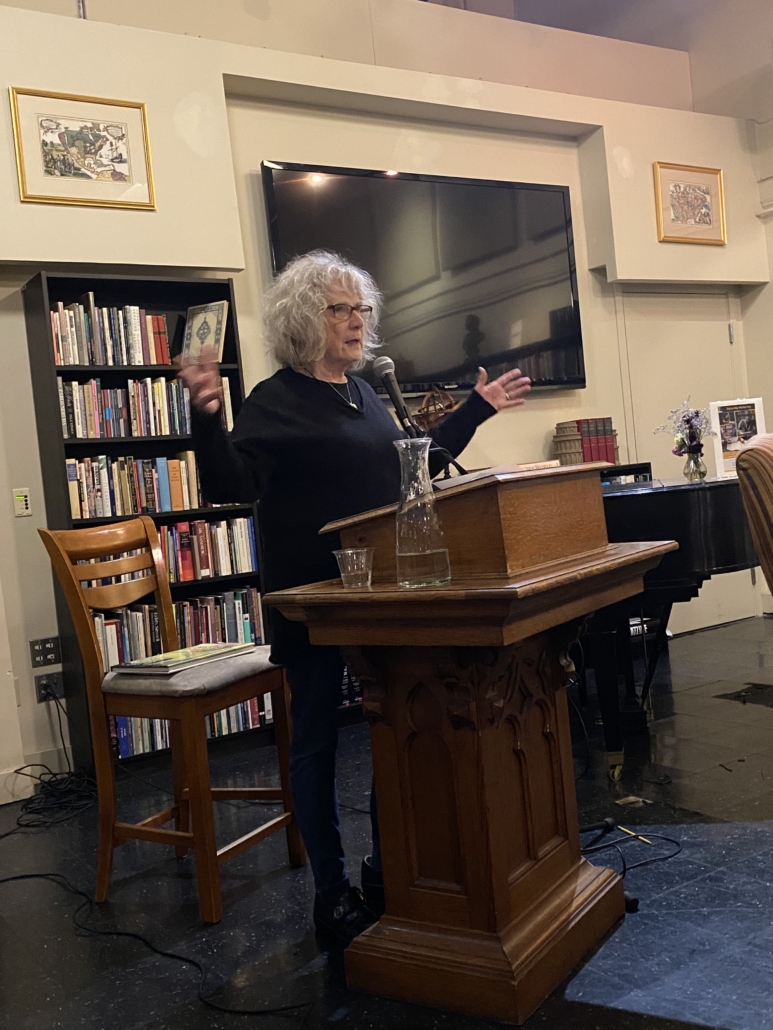
Priscilla Long at Folio, Feb. 2026

The Autobiography of Rain

THE AUTOBIOGRAPHY OF RAIN, Lana Hechtman Ayers. Fernwood Press, 2024.

Lana Hechtman Ayers is a one-woman poetry dynamo. She is the managing editor of three Pacific Northwest poetry presses: MoonPath Press, Concrete Wolf Poetry Series, and World Enough Writers. She also leads generative workshops, helps people assemble their books of poems, teaches at conferences, and writes her own poetry. To borrow the phrasing from the end of her poem, “A Blue True Dream,” her writing mantra must be “yes and yes and / illimitably yes.”  

In The Autobiography of Rain, her eleventh and most recent collection of poems, rain patters, welcome, relieving. “The rain is my best friend,” she writes in “Nineteen Things No One Knows about Me (And One They Do)”: “She knows how to keep a secret / and wash away the evidence.” Humor, sometimes, but rain also shows up hand-in-hand with grief. In “Landscape in Dreams”:

Where is it you go
when I lose sight of you in fog?
I’m certain I’ve seen you in dreams
that smell of burnt toast
On rainy days your laughter chimes
raindrops against roof gutter (27)

Oliver de la Paz uses these words to praise the book: “The fickle and atmospheric weather of losses, revelations, and heartbreak shifts and shimmers.” In poems such as “Reasons to Live,” and “On the Nature of Grief,” I was reminded that indeed this is poetry that “shifts and shimmers,”  that encompasses, becomes a voice talking back to you on a suicide hotline, sits beside you, faithful as a loved dog.

But these poems can also provide a nudge out of yourself, a gentle push toward something brighter.

“Poetry reveals there is no empty space”

Hafiz

Out of the void: dishes, dust, screens, fire fight, firefly
glimpses, tipsy kisses, too little, too much, lingering
rosemary, cups of coffee, bitterness of heartbreak, guitar
chords from the basement, implicit threat, green rage,
Stevie Wonder, Beethoven, Janis Joplin, the Kosciuszko
Bridge, windows open wide, something unforgivable,
traffic, too hot, too cold, weight squarely in my body,
wooden spoon, stream, salt of grief, loneliness, barking
dog, pearls, pencils, hand stirring the pot, books, wind,
rain furrows, moonrise, alchemy, edgelessness, yawns.
It was a Monday.

—Lana Hechtman Ayers

You can learn more about the author at her website (and you should!): https://lanaayers.com/index2.htm

The Autobiography of Rain is available at Fernwood Press, or can be ordered at Bookshop.org.


NPM #2: Oubliettes of Light

OUBLIETTES OF LIGHT, Lisa Ashley. MoonPath Press, P.O. Box 445, Tillamook, OR 27142, 2025, 73 pages, $17.99, paper, http://MoonPathPress.com.

What a pleasure for me to begin National Poetry Month with a blog-review of Lisa Ashley’s debut book of poetry, Oubliettes of Light.

An oubliette is a secret dungeon, accessible only through a trapdoor at the top. In these poems, we encounter multiple trapdoors, and we drop through them into dark, painful histories: the Armenian genocide, fragmented stories of violence handed down through the generations (along with family recipes, and a thirst for survival). A father provides for his family, and bullies and abuses his wife and children. A mother escapes into her flower garden, and into a bottle of Scotch. Lisa Ashley, the middle child of seven, escapes the family home in rural New York State, makes her way West, finds love and motherhood, becomes a chaplain working with incarcerated youth.

And, lucky for us, she eventually finds her way to poetry.

In my attempt to capture Ashley’s book in a quick paragraph, I had to ask myself, what makes me love this book? Why would I call it a pleasure? Why will anyone else love these poems? Let me walk you through my thought process. Consider these lines opening the first poem, “Grandmother’s Story Stone”:

I know no Armenian, she no English.
Like a pupil at attention, she sits
in her straight chair by the cookstove,
shuffles pages back to front
in her Armenian Bible. She mutters,
gnarled fingers rowing.

Several lines later we get our first glimpse of the poet: “I whisper behind my hand / scubbity, scubbity, scubbity.” How else to translate an incomprehensible past? What do you hear: scubbity. What do you see: “cotton stockings [as they] sloop / into ankle bracelets.” What do you smell: “garlic, olive oil, mint, her perfume.”

Above all, these are poems of witness. Necessary to the times we live in.

But, importantly, the poems in Oubliettes of Light are not trapdoors one falls through into darkness, they are not about trauma. These poems are about healing from trauma. They are about the solace one finds in a well-lived maturity. Not dungeons, but the unexpected doors opening above us into light. A child and a young adult taking in all that happens around her and processing it; a woman on a spiritual path of awareness and reclamation.

I Went Out to Hear

after Leila Chatti

I went out to hear
birdsong. Layered
in springtime air like icing
on cake sweet
clamor of joy,
praise song to life.
I hear the undertow of bees,
find one dancing
on the poppy’s green ball
in the arms of ivory pistils,
lavender petals ten times the bee’s size
wave a Victorian fan flirtation.
Standing stock still, eyes locked,
knees heavy with pollen, I’m lost,
beat fevered wings
willing to work
this singular moment forever.

—Lisa Ashley

Years of work—personal work on herself, and work on the poetry—went into the making of this book. It shows on every page. Because I know how late she came to poetry, and how seriously she has taken it, I asked Lisa to describe her writing journey. This is what she wrote back (with her permission, I have lightly edited and shortened it) — it’s a blueprint for the later-in-life poet:

I was 60 years old when I crossed the threshold from prose writing (journalism, marketing, academic papers, sermons) to poetry writing. I was an absolute neophyte. My fundamental love of learning was my ally. It was like finding a secret, enormous treasure trove. I had never studied poetry in college. I had never read poetry in any serious way. I was familiar with Mary Oliver’s work because her poems were used so often in Unitarian Universalist services that folks in the congregations referred to themselves as the “Church of Mary Oliver.” I liked her work and the few poets I had come across in the past: Robert Frost, Emily Dickinson, Shakespeare. I had no grounding in how to read and appreciate poetry, although I felt drawn to it. In 2014, after a sermon, a congregant invited me to come to her writing group. I knew her to be a kind person so I went. From there I began to take online classes and workshops, taught by excellent poets including Ellen Bass, Jane Hirshfield, Dorianne Laux, James Crews and Danusha Laméris. I joined a newly formed workshop group on Bainbridge and subscribed to on-line poetry venues that delivered a poem daily to my inbox. I was eager to learn as much as I could. I wrote many poems and began to submit to journals. I published my first poem in 2019. In May 2024 I submitted my manuscript to MoonPath Press, to the Sally Albiso Award contest. I was a finalist and was chosen for publication. I continue to read poetry every day, listen to poetry podcasts, and have committed to writing a poem a day for National Poetry Month. You could say I approach poetry as an immersive experience, and write poems to explore who I am, and to heal.

In closing, this is an inspiring book, open-hearted and encouraging.

You can find Oubliettes of Light at MoonPath, or through Bookshop.org. To see Lisa’s brand new (and lovely) web site, follow this link: https://www.lisaashleypoet.com.